
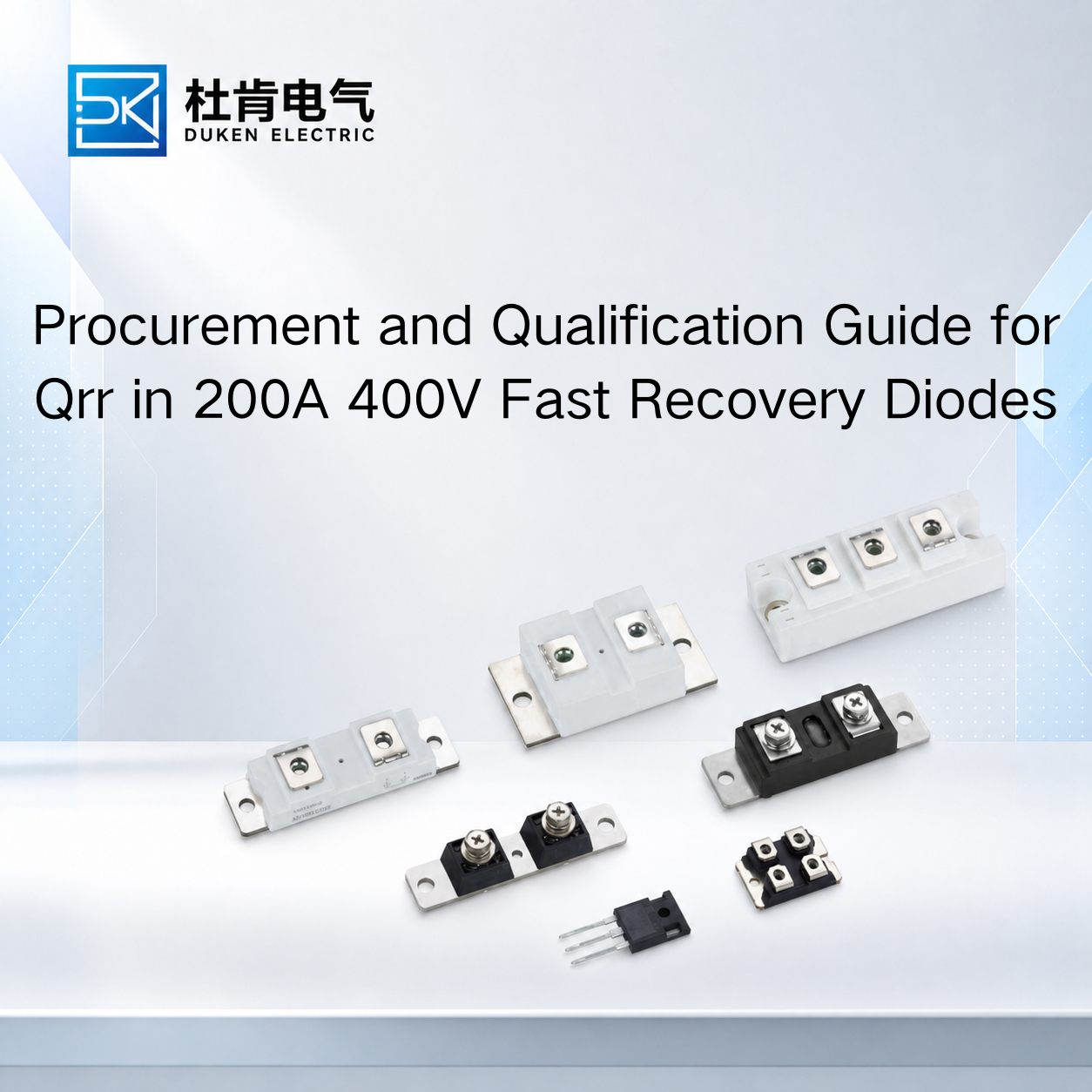
Procurement and Qualification Guide for Qrr in 200A 400V Fast Recovery Diodes
Understanding Qrr in 200A 400V Fast Recovery Diodes: What Buyers Must Know becomes especially important when an OEM needs to qualify a new supplier, replace an obsolete diode, or establish a second source for an existing power converter. A candidate device may match the original 200A current rating, 400V voltage class, and mechanical package while behaving differently during commutation. Reverse recovery charge can affect switching loss, IGBT or MOSFET turn-on stress, voltage overshoot, and operating temperature. For industrial buyers, Qrr should therefore be included in a broader qualification process covering forward voltage, recovery time, leakage current, surge capability, thermal resistance, package dimensions, polarity, mounting requirements, and application-level testing.
Turn Qrr into a Practical Procurement Specification
A purchasing request containing only “200A 400V fast recovery diode” leaves too much room for interpretation.
The first qualification stage should define how the diode is used. A component operating in a 50/60 Hz industrial rectifier has different priorities from one commutating repeatedly in a welding inverter or switched power converter.
Qrr describes the charge associated with reverse recovery when a silicon PN diode transitions from forward conduction to reverse blocking:
Qrr = ∫ |iR(t)| dt
This specification should be reviewed together with trr and peak reverse recovery current. More importantly, buyers should examine the conditions under which the values were measured.
Forward current, junction temperature, di/dt, and reverse conditions can all influence the observed recovery behavior. A supplier showing a smaller Qrr value under easier test conditions should not automatically be considered technically superior.
This is one of the most important purchasing lessons in Understanding Qrr in 200A 400V Fast Recovery Diodes: What Buyers Must Know. Datasheet numbers become meaningful only when the test conditions are sufficiently comparable.
When an exact cross-reference is unavailable, procurement teams should provide the original datasheet together with information about the actual equipment. Switching frequency, load current, cooling method, package requirements, and circuit function can help the supplier propose a technically appropriate alternative rather than simply matching the headline ratings.
Qualifying a Vishay Equivalent Beyond Current and Voltage
Second-source qualification often begins with an established manufacturer part number. This can be useful, but the term “equivalent” needs to be handled carefully.
A brand Vishay equivalent glass-metal seal housing low conduction loss 200A 400V fast recovery diode should be evaluated as an application-compatible alternative. The description should not be interpreted as meaning that the product is manufactured by Vishay or that every electrical characteristic is identical.
Forward voltage deserves particular attention because it affects conduction loss:
Pcond ≈ VF × IF(avg)
At 200A-class currents, even a modest difference in forward voltage can influence semiconductor temperature and heat-sink requirements.
Qrr must then be considered alongside VF. A candidate with lower conduction loss may still create higher switching-related stress if its reverse recovery behavior differs substantially from the original device.
Reverse leakage is another useful comparison parameter, particularly at elevated temperature. Since leakage current is temperature dependent, buyers should avoid comparing a room-temperature value from one manufacturer with a hot-state value from another.
For a brand Vishay equivalent glass-metal seal housing low conduction loss 200A 400V fast recovery diode, procurement qualification should also examine Rth(j-c), applicable junction-temperature limits, surge capability, package construction, dimensions, and terminal configuration.
This broader comparison helps distinguish genuine application compatibility from superficial model matching.
For critical industrial equipment, samples should be tested before a larger order is approved. A supplier's cross-reference table is useful for identifying candidates, but it should not replace engineering validation.
Mechanical Qualification of 3/4″-16UNF Stud Type DO-9 Devices
Mechanical interchangeability is particularly important for replacement projects involving stud-mounted rectifier assemblies.
A 3/4″-16UNF stud type for bridge rectifier module stud mount DO-9 200A 400V fast recovery diode may appear easy to replace because the thread and external package are readily identifiable. However, the thread specification alone does not establish compatibility.
The mechanical drawing should be compared for overall dimensions, stud length, terminal geometry, and installation clearances. Stud polarity must also be verified because different diode configurations can connect the stud to different semiconductor electrodes.
This can directly affect an existing bridge rectifier assembly where the heat sink or mounting plate is electrically conductive.
Thermal installation should also be considered. The stud and mounting structure can form an important heat-transfer path. Surface condition and manufacturer-specified mounting requirements therefore influence thermal performance.
A 3/4″-16UNF stud type for bridge rectifier module stud mount DO-9 200A 400V fast recovery diode should consequently be evaluated for mechanical, electrical, and thermal compatibility together.
Application type then determines how much emphasis should be placed on Qrr.
For line-frequency rectification, conduction loss, thermal resistance, surge capability, and mechanical robustness may have greater influence on practical reliability. For faster commutation circuits, Qrr and trr become increasingly important.
This is why OEM buyers should tell suppliers where the diode is used instead of requesting a quotation from package information alone.
Application Testing for High-Speed Power Converters
A high switching speed industrial power converter low reverse leakage current 200A 400V fast recovery diode should ideally be tested in the intended switching circuit before volume approval.
The reason is that reverse recovery interacts with other components.
When an IGBT turns on and commutates current from the diode, it may temporarily conduct both load current and reverse recovery current. This can increase transistor turn-on energy.
Parasitic inductance can also generate additional voltage during rapid current changes:
V = L × di/dt
The resulting overshoot and ringing depend not only on the diode but also on busbar geometry, connection inductance, snubber design, transistor switching speed, and gate-drive conditions.
Application testing should therefore examine the complete commutation behavior.
For a high switching speed industrial power converter low reverse leakage current 200A 400V fast recovery diode, useful comparisons include recovery-current waveform, voltage overshoot, diode case temperature, transistor temperature, and converter behavior under representative load.
Testing should also include realistic thermal conditions. A short room-temperature bench test may not reveal behavior after the semiconductor and heat sink reach thermal equilibrium.
This becomes especially important when approving a second source. Testing the original and replacement in the same equipment under the same conditions creates a much stronger technical comparison than relying on isolated datasheet numbers.
Building a Reliable Second-Source Strategy
Component availability has become an important consideration for industrial equipment with long service lives. OEMs and distributors may need alternative suppliers because of lead-time changes, discontinued models, or the need to reduce dependence on a single source.
However, second sourcing should not reduce technical qualification to matching voltage and current.
A standard rectifier diode may be suitable for low-frequency rectification but generally cannot replace an FRD in a circuit where fast recovery is necessary. A silicon FRD offers mature high-current capability with improved recovery behavior and remains practical for many industrial switching applications.
SiC Schottky diodes can provide very low minority-carrier reverse recovery and may reduce switching losses substantially in higher-frequency converters. However, moving from silicon FRD to SiC can involve differences in conduction characteristics, package availability, surge behavior, system design, and cost.
For an established converter, the most practical second source may therefore be another silicon FRD with sufficiently similar dynamic, thermal, and mechanical behavior.
Batch consistency also deserves attention after samples are approved. Incoming inspection can verify identity, package condition, polarity, and selected electrical characteristics according to the buyer's quality requirements. For critical projects, traceability between qualification samples and production lots can provide additional confidence.
This procurement discipline captures the broader meaning of Understanding Qrr in 200A 400V Fast Recovery Diodes: What Buyers Must Know. Qrr is not simply a laboratory specification; it is one part of determining whether a diode can operate reliably in a real industrial power system.
Conclusion
Selecting a 200A 400V fast recovery diode requires a structured qualification process that connects Qrr with the actual application.
Buyers should compare Qrr only under meaningful test conditions and evaluate it alongside trr, VF, reverse leakage, thermal resistance, surge capability, and junction-temperature requirements. Mechanical characteristics such as stud dimensions and polarity are equally important when replacing DO-9 devices.
For high-frequency converters, application testing should verify how the candidate diode interacts with the IGBT or MOSFET, circuit inductance, gate drive, cooling system, and actual load.
The best second-source diode is therefore not simply the product with the lowest published Qrr or lowest price. It is the device whose dynamic, static, thermal, and mechanical characteristics have been demonstrated to provide an appropriate match for the equipment in which it will operate.
FAQ
Q1: What should buyers request when comparing Qrr between suppliers?
Request the Qrr value together with its test conditions, particularly forward current, junction temperature, di/dt, and other relevant recovery-test conditions.
Q2: Can a Vishay-equivalent diode have different Qrr?
Yes. An application-compatible alternative does not necessarily have identical characteristics. Qrr and other relevant parameters should be compared and validated for the intended circuit.
Q3: Is matching a 3/4″-16UNF thread enough for replacement?
No. Stud polarity, package dimensions, terminal arrangement, thermal requirements, electrical characteristics, and mounting conditions must also be checked.
Q4: How should a second-source FRD be qualified?
Start with a complete datasheet comparison, then test representative samples under realistic current, switching, thermal, and cooling conditions before approving volume production.
Q5: Should buyers replace silicon FRDs with SiC to eliminate Qrr?
Not automatically. SiC can greatly reduce recovery-related losses, but conduction characteristics, package compatibility, surge requirements, cost, and converter architecture must also be considered.
READ MORE:
Qrr and Thermal Reliability in 200A 400V Fast Recovery Diodes for Industrial Power Systems
How to Compare Qrr Specifications When Selecting a 200A 400V Fast Recovery Diode
How Qrr Affects Switching Loss and IGBT Stress in 200A 400V Fast Recovery Diodes
Understanding Qrr in 200A 400V Fast Recovery Diodes: What Industrial Buyers Must Know
Preventing Overheating and Extending Service Life of 200A 400V Fast Recovery Diodes
Thermal Reliability Design for 200A 400V Fast Recovery Diodes in Bridge Rectifiers
Reverse Recovery Loss and Cooling Optimization for 200A 400V Fast Recovery Diodes
Reducing Junction Temperature in 200A 400V Fast Recovery Diodes Through Package and Mounting Design
How to Improve Thermal Management of a 200A 400V Fast Recovery Diode in Industrial Power Converters