
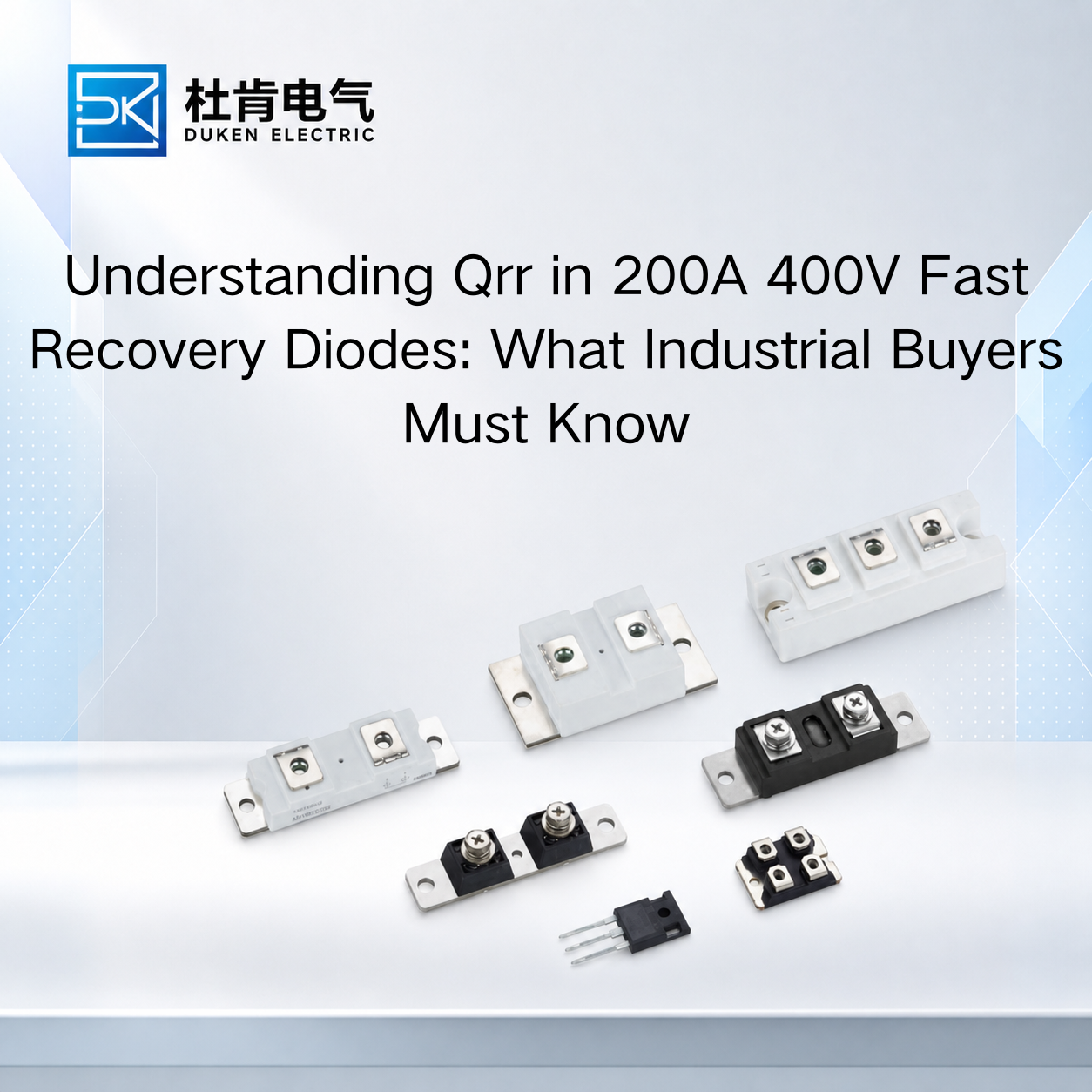
Understanding Qrr in 200A 400V Fast Recovery Diodes: What Industrial Buyers Must Know
Understanding Qrr in 200A 400V Fast Recovery Diodes: What Buyers Must Know is important when selecting components for welding inverters, UPS systems, motor drives, bridge rectifiers, and industrial power converters. Buyers often compare current rating, reverse voltage, forward voltage, and recovery time first, but reverse recovery charge, or Qrr, can have a major influence on switching loss and stress in the surrounding circuit. Two 200A 400V fast recovery diodes may look interchangeable on a purchasing list while producing noticeably different behavior once installed. For OEM engineers and procurement managers, Qrr should therefore be evaluated together with trr, reverse recovery current, VF, leakage current, temperature, package construction, and actual converter operating conditions.
What Qrr Actually Tells You About a Fast Recovery Diode
A silicon PN diode does not stop conducting instantly when the circuit changes from forward bias to reverse bias. During forward conduction, minority carriers are stored within the semiconductor. When reverse voltage is applied, this stored charge must first be removed before the diode establishes its normal reverse-blocking state.
During this process, reverse current flows for a short period.
Qrr represents the reverse recovery charge associated with this transition and is related to the area under the reverse recovery current waveform. It is usually expressed in microcoulombs for high-current power devices.
This is different from trr.
Reverse recovery time describes the duration of the recovery event under specified test conditions, while Qrr indicates the amount of charge involved. Peak reverse recovery current provides another view of the same switching event.
For procurement purposes, this distinction matters. Selecting a diode solely because it has a shorter trr does not guarantee that it will create lower switching loss in the customer's converter.
Test conditions must also be considered. Qrr is affected by factors including forward current before commutation, current rate of change, junction temperature, and the test circuit. Comparing values from two manufacturers without checking these conditions can therefore produce misleading conclusions.
This is one of the central points in Understanding Qrr in 200A 400V Fast Recovery Diodes: What Buyers Must Know: the number is meaningful only when its measurement conditions and application context are understood.
Why Qrr Matters in High Switching Speed Industrial Power Converters
The effect of Qrr becomes more important as switching frequency increases.
Consider a high switching speed industrial power converter low reverse leakage current 200A 400V fast recovery diode operating alongside an IGBT or MOSFET. When the transistor turns on and commutates current away from the diode, it may need to carry the diode's reverse recovery current in addition to the normal load current.
That additional current can increase transistor turn-on stress and switching energy.
At the same time, parasitic inductance in the commutation loop can create additional voltage:
V = L × di/dt
High recovery current combined with high di/dt and circuit inductance can therefore contribute to voltage overshoot, ringing, EMI, and additional stress on both the diode and switching transistor.
This explains why diode recovery behavior can influence the thermal performance of components located elsewhere in the power stage.
Switching loss also accumulates with frequency. A simplified relationship is:
Psw ≈ Esw × fs
If energy is dissipated during every switching event, increasing switching frequency increases average switching-related power loss.
For a high switching speed industrial power converter low reverse leakage current 200A 400V fast recovery diode, buyers should consequently review Qrr, trr, recovery-current behavior, and leakage alongside the converter's operating frequency and transistor technology.
Low reverse leakage remains valuable, particularly at elevated temperature, but it does not replace good recovery performance. Leakage current and Qrr describe different operating states and should not be treated as interchangeable quality indicators.
Qrr Versus VF: Finding the Right Loss Balance
One of the more difficult purchasing decisions is balancing reverse recovery performance against forward conduction loss.
Forward loss can initially be estimated as:
Pcond ≈ VF × IF(avg)
At 200A-class current levels, VF matters considerably. A difference in forward voltage that looks small on a datasheet can translate into meaningful additional heat under sustained high-current operation.
This makes a brand Vishay equivalent glass-metal seal housing low conduction loss 200A 400V fast recovery diode attractive for applications where conduction periods are relatively long.
However, buyers should avoid focusing exclusively on VF.
A diode optimized for lower conduction loss does not automatically have the best reverse recovery characteristics for every switching application. Semiconductor design involves trade-offs, and the best balance depends on topology, switching frequency, current waveform, temperature, and cooling conditions.
For an industrial rectifier operating mainly at line frequency, low VF and strong current or surge capability may deserve greater emphasis because switching events occur relatively infrequently.
For a welding inverter or switched industrial power converter, Qrr can become much more important because the diode repeatedly transitions between forward conduction and reverse blocking.
Therefore, a brand Vishay equivalent glass-metal seal housing low conduction loss 200A 400V fast recovery diode should be qualified as an application-equivalent component rather than selected because the supplier describes it as a Vishay equivalent.
Equivalent should mean that the relevant electrical, thermal, mechanical, and dynamic characteristics meet the application's requirements. It should not be interpreted as evidence that the product is original Vishay or automatically identical in every characteristic.
Qrr Selection for 3/4″-16UNF Stud Type DO-9 Diodes
Mechanical compatibility adds another dimension to diode sourcing.
A 3/4″-16UNF stud type for bridge rectifier module stud mount DO-9 200A 400V fast recovery diode may be selected because it fits an existing rectifier assembly, heat sink, or busbar structure. But identical thread size and package appearance do not establish electrical equivalence.
Buyers should verify stud polarity, package dimensions, mounting requirements, forward voltage, blocking voltage, current rating, thermal resistance, leakage, and recovery characteristics.
Qrr should then be evaluated according to the actual function of the diode.
If the stud diode is used in a relatively low-frequency industrial rectifier, exceptionally low Qrr may provide limited practical benefit compared with lower conduction loss, suitable surge capability, and reliable thermal contact.
If the same package is used in a faster commutation circuit, recovery behavior becomes more significant.
For a 3/4″-16UNF stud type for bridge rectifier module stud mount DO-9 200A 400V fast recovery diode, mounting quality can also influence operating temperature. The manufacturer's specified mounting conditions should be followed because the stud connection may form an important thermal path into the heat sink.
This highlights a broader purchasing principle: Qrr should never be evaluated separately from the physical system in which the diode operates.
Comparing Silicon FRD, Standard Diodes and SiC
Technology comparison helps clarify when Qrr deserves the greatest attention.
A conventional silicon rectifier diode is optimized primarily for rectification rather than rapid recovery. It can be an economical and robust solution for line-frequency applications where switching speed is not a primary requirement.
A silicon fast recovery diode is designed to recover more rapidly, making it more suitable for higher-frequency switching circuits. Qrr and trr therefore become important selection parameters.
SiC Schottky diodes behave differently. Because they do not exhibit the same minority-carrier storage mechanism as silicon PN fast recovery diodes, they have very low reverse recovery associated with stored minority charge.
This can substantially reduce commutation losses and transistor turn-on stress in high-frequency converters.
However, SiC is not automatically the correct replacement for every silicon FRD. At 200A-class current levels, engineers still need to consider forward conduction loss, surge requirements, package availability, mechanical compatibility, cooling architecture, cost, and supply continuity.
For established industrial equipment, a properly selected silicon FRD may offer the better balance of electrical performance, mechanical compatibility, and procurement cost. For new converters operating at higher switching frequencies, SiC can become more attractive when reduced recovery loss delivers a measurable system-level advantage.
Conclusion
Understanding Qrr in 200A 400V Fast Recovery Diodes: What Buyers Must Know ultimately comes down to recognizing that Qrr is a system parameter as much as a component specification.
Lower Qrr can reduce reverse recovery current, switching stress, and losses in suitable high-frequency circuits, but it should not be considered independently from trr, VF, leakage current, thermal resistance, package design, and measurement conditions.
For procurement managers and engineers evaluating second-source components, the strongest approach is to compare datasheets under equivalent test conditions and then validate samples in the actual converter. Current waveforms, switching behavior, case temperature, voltage overshoot, and associated transistor temperature can reveal differences that a simple 200A/400V comparison cannot.
A well-selected fast recovery diode is therefore not necessarily the device with the lowest Qrr number. It is the device whose conduction, recovery, blocking, thermal, and mechanical characteristics provide the best overall match for the intended industrial application.
FAQ
Q1: What does Qrr mean in a fast recovery diode?
Qrr is the reverse recovery charge associated with the transition from forward conduction to reverse blocking. It helps characterize how much stored charge must be removed during commutation.
Q2: Is lower Qrr always better?
Not automatically. Lower Qrr can reduce switching-related stress, but VF, leakage, surge capability, thermal performance, package compatibility, and actual operating conditions must also be considered.
Q3: What is the difference between Qrr and trr?
Qrr describes reverse recovery charge, while trr describes recovery time under specified test conditions. Both should be reviewed when evaluating switching behavior.
Q4: Why can diode Qrr affect IGBT temperature?
During diode recovery, the IGBT may carry additional reverse recovery current as it turns on. This can increase IGBT switching energy and junction temperature.
Q5: Does a SiC diode have the same reverse recovery behavior as a silicon FRD?
No. SiC Schottky diodes have very low minority-carrier reverse recovery compared with silicon PN fast recovery diodes, which can provide significant benefits in high-frequency converters.
READ MORE:
Procurement and Qualification Guide for Qrr in 200A 400V Fast Recovery Diodes
Qrr and Thermal Reliability in 200A 400V Fast Recovery Diodes for Industrial Power Systems
How to Compare Qrr Specifications When Selecting a 200A 400V Fast Recovery Diode
How Qrr Affects Switching Loss and IGBT Stress in 200A 400V Fast Recovery Diodes
Preventing Overheating and Extending Service Life of 200A 400V Fast Recovery Diodes
Thermal Reliability Design for 200A 400V Fast Recovery Diodes in Bridge Rectifiers
Reverse Recovery Loss and Cooling Optimization for 200A 400V Fast Recovery Diodes
Reducing Junction Temperature in 200A 400V Fast Recovery Diodes Through Package and Mounting Design
How to Improve Thermal Management of a 200A 400V Fast Recovery Diode in Industrial Power Converters