
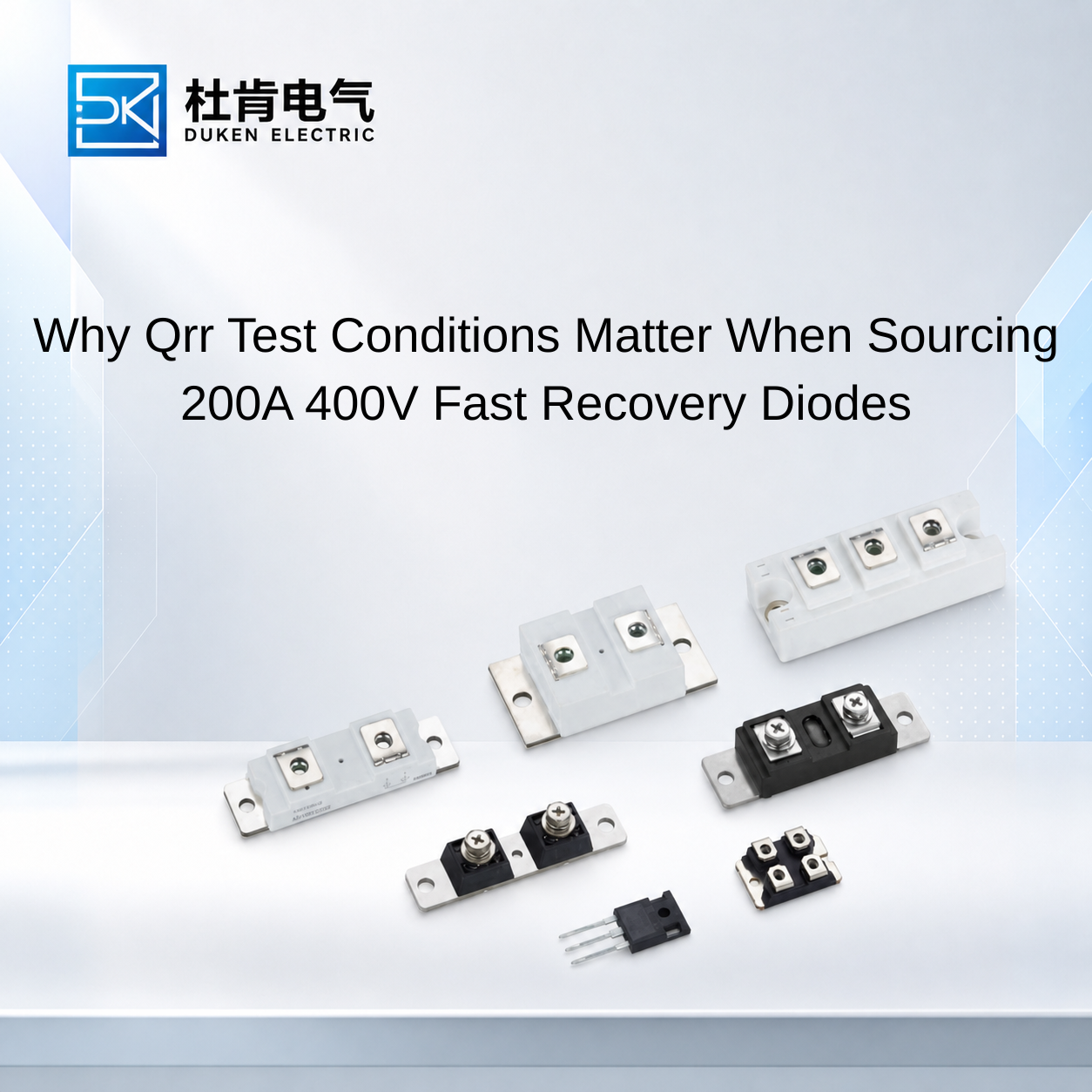
Why Qrr Test Conditions Matter When Sourcing 200A 400V Fast Recovery Diodes
Understanding Qrr in 200A 400V Fast Recovery Diodes: What Buyers Must Know becomes especially important when procurement teams compare datasheets from different manufacturers. Qrr, or reverse recovery charge, is often treated as a simple performance number: the lower the value, the faster and more efficient the diode appears. In practice, Qrr depends heavily on test conditions, including forward current, junction temperature, commutation di/dt, and circuit conditions. For industrial equipment manufacturers sourcing replacement or second-source diodes, ignoring these conditions can lead to incorrect comparisons, unexpected IGBT switching losses, higher operating temperatures, or unstable converter behavior.
For this reason, Qrr should be interpreted as part of a complete application assessment rather than as an isolated purchasing specification.
Why the Same 200A 400V Rating Can Produce Different Qrr Behavior
A silicon fast recovery diode stores minority carriers while conducting forward current. When the circuit forces the diode from forward conduction into reverse blocking, these carriers must be removed before the device can fully block reverse voltage.
The reverse current flowing during this transition creates the reverse recovery waveform. Qrr can be understood as the charge represented by this waveform:
Qrr = ∫ |iR(t)| dt
This immediately shows why Qrr is different from trr. Reverse recovery time describes the duration of the recovery process, while Qrr represents the amount of charge involved. Peak reverse recovery current provides another important piece of information about the event.
The difficulty for buyers is that these parameters are not independent of test conditions.
For example, changing the forward current before commutation can change the stored charge. Junction temperature can influence carrier behavior, while the applied di/dt can change the magnitude and shape of the recovery-current waveform.
As a result, a diode specified with lower Qrr on one datasheet is not automatically superior to another product if the two manufacturers used different test conditions.
This is one of the most important lessons in Understanding Qrr in 200A 400V Fast Recovery Diodes: What Buyers Must Know. Procurement engineers should read the conditions beside the Qrr specification before creating a supplier comparison table.
If equivalent test data are unavailable, sample testing under common conditions provides a stronger technical basis for selection.
Qrr and VF Must Be Evaluated Together for Vishay Equivalent Selection
Industrial buyers frequently search for second-source components when an established semiconductor becomes expensive, difficult to obtain, or subject to long lead times.
A brand Vishay equivalent glass-metal seal housing low conduction loss 200A 400V fast recovery diode can be a practical option, but “equivalent” should refer to application compatibility rather than merely matching 200A and 400V.
Forward voltage is particularly important because it influences conduction loss. A simplified estimate is:
Pcond ≈ VF × IF(avg)
At high current, even a moderate difference in VF can affect total heat generation. This makes low conduction loss attractive in applications with long conduction periods.
However, selecting only by VF can create another problem.
A diode may provide favorable conduction characteristics while having different reverse recovery behavior from the original device. In a higher-frequency converter, additional Qrr can increase switching-related losses and impose greater turn-on stress on the associated IGBT or MOSFET.
A brand Vishay equivalent glass-metal seal housing low conduction loss 200A 400V fast recovery diode should therefore be compared across VF, Qrr, trr, reverse leakage, thermal resistance, surge capability, junction-temperature limits, and mechanical characteristics.
Glass-metal seal housing compatibility can be important for established industrial assemblies, but matching the package does not prove that the internal semiconductor design or dynamic characteristics are identical.
For second-source qualification, the original component should be treated as the reference. The candidate can then be evaluated under the same current, temperature, switching, and cooling conditions.
This approach helps purchasing teams determine whether the alternative is genuinely suitable for the equipment rather than simply similar on paper.
Why Qrr Is Critical in High Switching Speed Industrial Power Converters
The importance of reverse recovery increases as switching frequency rises.
A high switching speed industrial power converter low reverse leakage current 200A 400V fast recovery diode may operate together with an IGBT or MOSFET that repeatedly commutates current from the diode.
When the transistor turns on, the diode does not necessarily stop conducting immediately. Reverse recovery current can temporarily flow through the switching path, increasing the current handled by the transistor during turn-on.
This can raise transistor switching energy and junction temperature.
The effect is repeated at every switching cycle. A useful simplified relationship is:
Psw ≈ Esw × fs
Therefore, a relatively small difference in switching energy per cycle can become important as switching frequency increases.
Circuit inductance also interacts with the recovery event:
V = L × di/dt
Rapid changes in current can produce voltage overshoot across parasitic inductance in busbars, semiconductor connections, and PCB conductors. Excessive recovery current can therefore contribute not only to heat but also to ringing, EMI, and voltage stress.
For a high switching speed industrial power converter low reverse leakage current 200A 400V fast recovery diode, low leakage is useful for reverse blocking, particularly at elevated temperature. Nevertheless, low IR does not compensate for unsuitable Qrr.
Engineers should consider both parameters because they describe different operating conditions.
This is particularly important in welding inverters, UPS converters, industrial motor drives, switched DC power systems, and similar equipment where the diode and transistor operate as an interacting switching pair.
Qrr Requirements for 3/4″-16UNF Stud Type DO-9 Diodes
Not every 200A fast recovery diode requires the same Qrr performance.
A 3/4″-16UNF stud type for bridge rectifier module stud mount DO-9 200A 400V fast recovery diode used in a lower-frequency rectifier may spend much more time conducting than undergoing rapid reverse recovery.
In such applications, VF, surge-current capability, thermal resistance, mechanical robustness, and heat-sink installation may be more important than obtaining the lowest possible Qrr.
The situation changes when a stud diode is used in a faster commutation circuit. Recovery charge then becomes a more significant contributor to switching performance and thermal stress.
This distinction should influence model selection.
A 3/4″-16UNF stud type for bridge rectifier module stud mount DO-9 200A 400V fast recovery diode must also be checked for stud polarity, mechanical dimensions, terminal configuration, and mounting requirements.
The stud may be electrically associated with the anode or cathode depending on the specific product. In a bridge rectifier mounted on conductive heat sinks, this difference can determine whether the candidate can be installed without redesigning the assembly.
Thermal contact is another consideration. The manufacturer's specified mounting requirements should be followed because the mechanical connection forms part of the heat-transfer path.
A diode with excellent Qrr can still be an unsuitable replacement if the mechanical or thermal interface does not match the existing equipment.
Selecting Between Standard Diodes, Silicon FRDs and SiC
Technology comparison provides useful context for Qrr selection.
A conventional silicon rectifier diode is well suited to line-frequency rectification where switching speed is not a primary requirement. Low VF, strong surge capability, mature packaging, and cost can be more important in these systems.
A silicon fast recovery diode is designed for faster commutation. Qrr and trr therefore become important parameters when selecting devices for industrial switching converters.
SiC Schottky diodes offer another approach. Because they have very low minority-carrier stored charge, they exhibit far less reverse recovery associated with the mechanism found in silicon PN fast recovery diodes. This can reduce transistor turn-on stress and switching losses in high-frequency converters.
However, SiC should not automatically replace a silicon FRD.
At the 200A level, forward conduction characteristics, package availability, surge requirements, cooling architecture, mechanical design, cost, and supply availability must also be considered.
For existing equipment using stud-mounted silicon devices, a qualified silicon FRD may provide a more straightforward second-source solution. For a newly designed high-frequency converter, SiC may offer greater system-level advantages when switching losses significantly affect efficiency and power density.
The correct technology depends on application conditions rather than a single recovery parameter.
Conclusion
Understanding Qrr in 200A 400V Fast Recovery Diodes: What Buyers Must Know requires procurement teams to look beyond the published Qrr number. Reverse recovery charge depends on measurement conditions and interacts with trr, peak recovery current, forward voltage, switching frequency, temperature, and circuit inductance.
For high-frequency converters, unsuitable Qrr can increase IGBT or MOSFET turn-on stress and contribute to additional thermal loss and voltage overshoot. In lower-frequency rectifiers, conduction loss, surge capability, package design, and thermal performance may deserve greater priority.
The best purchasing process is therefore to compare datasheets under equivalent conditions, confirm electrical and mechanical compatibility, and test representative samples in the actual application before approving bulk orders. This approach gives industrial OEMs and distributors a much stronger basis for identifying a genuinely compatible 200A 400V fast recovery diode.
FAQ
Q1: Why can two 200A 400V diodes have very different Qrr values?
Semiconductor design and test conditions both influence Qrr. Forward current, junction temperature and di/dt can significantly affect the measured recovery behavior.
Q2: Is a lower Qrr always better for industrial equipment?
No. Lower Qrr can benefit high-frequency switching, but VF, surge capability, leakage, thermal resistance, package compatibility and application frequency must also be considered.
Q3: Does Qrr affect IGBT switching loss?
Yes. During reverse recovery, the IGBT may temporarily conduct additional recovery current during turn-on, which can increase switching energy.
Q4: Is Qrr important for a stud-type bridge rectifier diode?
It depends on operating frequency. In lower-frequency rectification, conduction and thermal characteristics may be more important. In faster commutation circuits, Qrr becomes more significant.
Q5: Can SiC eliminate reverse recovery problems?
SiC Schottky diodes have very low minority-carrier reverse recovery, but they should still be evaluated for conduction loss, surge capability, package compatibility, cost, and overall system requirements.
READ MORE:
From Emergency Stock to Long-Term Supply: Qualifying a 300A Phase Control Thyristor
Lead Time vs Technical Fit: Buying a 300A Phase Control Thyristor from Stock
Selecting an In-Stock 300A Phase Control Thyristor for High-Current Rectifier Systems
How In-Stock 300A Phase Control Thyristors Reduce Downtime in Industrial Power Systems
300A Phase Control Thyristor in Stock: What Industrial Buyers Should Verify Before Ordering
Supplier Qualification Checklist for 200A 400V Fast Recovery Diodes: From Qrr to Batch Consistency
Thermal and Reliability Risks of Qrr in 200A 400V Fast Recovery Diodes
How to Evaluate Qrr, Irr and trr in 200A 400V Fast Recovery Diodes
How Qrr Influences Efficiency and Device Selection in 200A 400V Fast Recovery Diodes