
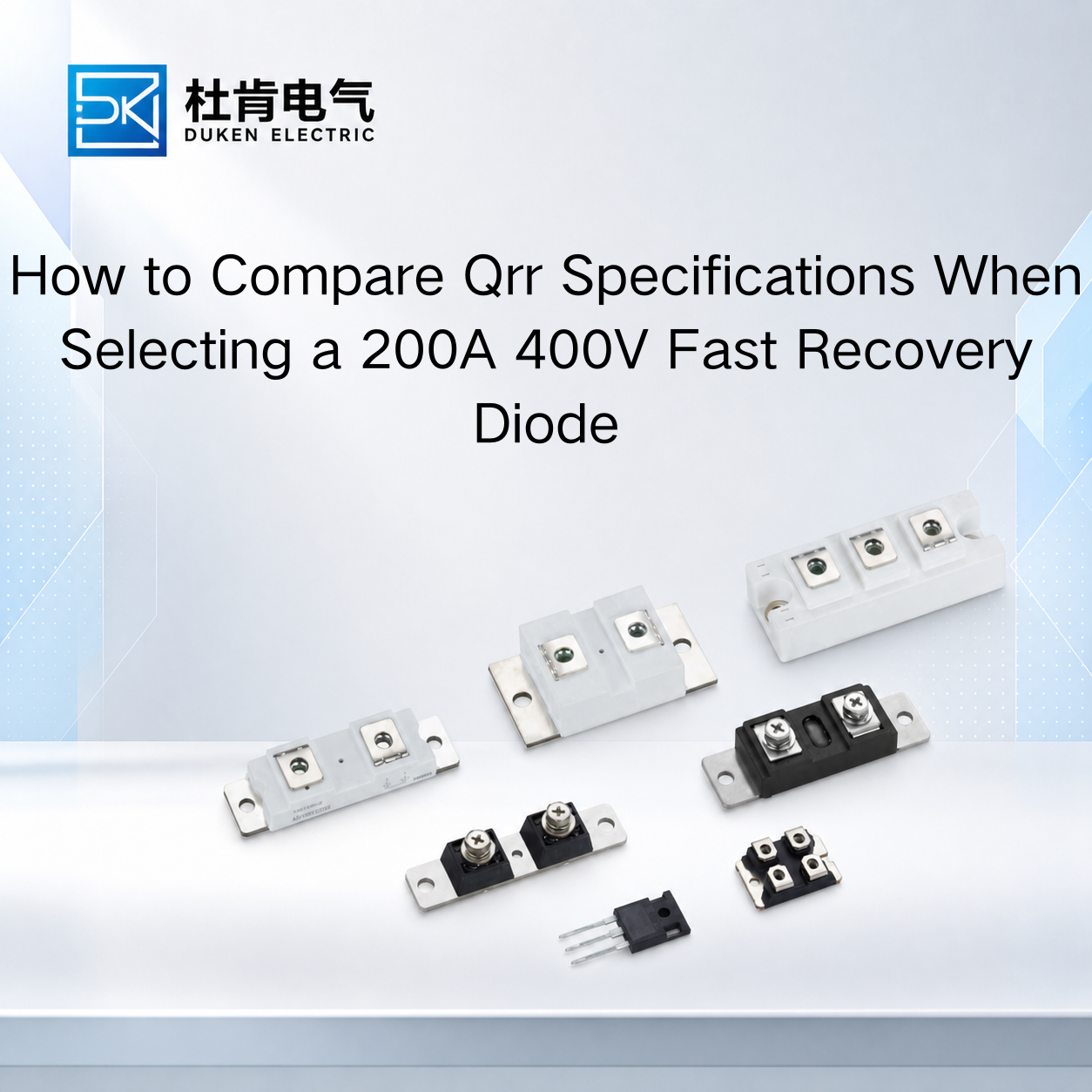
How to Compare Qrr Specifications When Selecting a 200A 400V Fast Recovery Diode
For procurement managers and engineers, Understanding Qrr in 200A 400V Fast Recovery Diodes: What Buyers Must Know is especially important when comparing alternative suppliers. Two datasheets may list the same 200A current rating and 400V blocking voltage, yet their reverse recovery characteristics can differ significantly. Even when both products provide Qrr and trr values, those numbers may have been measured at different forward currents, temperatures, or di/dt conditions. A direct numerical comparison can therefore lead to the wrong sourcing decision. For industrial converters, welding power supplies, UPS systems, and bridge rectifiers, buyers should evaluate Qrr together with VF, leakage current, thermal resistance, package compatibility, and the actual switching environment.
Why Qrr Numbers from Different Datasheets Are Not Always Comparable
Reverse recovery occurs when a silicon PN diode changes from forward conduction to reverse blocking. During forward conduction, minority carriers are stored within the semiconductor. When reverse voltage is applied, this stored charge must be removed before the diode fully establishes reverse blocking.
Qrr represents the reverse recovery charge associated with this transition. Conceptually, it corresponds to the charge represented by the reverse-current waveform during recovery:
Qrr = ∫ |iR(t)| dt
This is why Qrr provides information that trr alone cannot.
A shorter trr does not necessarily mean that a diode has proportionally lower recovery charge or will generate less switching stress. The magnitude and shape of the recovery-current waveform also matter.
More importantly for buyers, Qrr is not an isolated material constant. Its measured value depends on test conditions.
Forward current before commutation influences the amount of stored charge. The current rate of change during commutation can influence the recovery waveform. Junction temperature also affects carrier behavior and recovery characteristics.
Therefore, if Supplier A publishes Qrr at one current and temperature while Supplier B uses substantially different conditions, simply selecting the smaller number is technically weak.
This is a central issue in Understanding Qrr in 200A 400V Fast Recovery Diodes: What Buyers Must Know. Procurement teams should compare the test conditions printed beside the specification, not only the headline Qrr value.
When conditions differ too much for a meaningful comparison, requesting additional technical data or testing samples under common conditions is more reliable.
Comparing Qrr, trr, VF and Leakage as a Complete Set
An industrial diode cannot be selected from Qrr alone because different losses dominate under different operating conditions.
Forward conduction loss can be approximated initially as:
Pcond ≈ VF × IF(avg)
At high current, this becomes important. A diode operating with a relatively high duty cycle may spend much more time conducting than recovering, particularly in moderate-frequency equipment.
This explains why a brand Vishay equivalent glass-metal seal housing low conduction loss 200A 400V fast recovery diode should be compared for VF as well as Qrr.
If a proposed equivalent offers attractive recovery characteristics but significantly increases forward conduction loss, the resulting junction temperature may not improve.
Conversely, selecting the lowest-VF diode without examining reverse recovery may create additional switching loss in a higher-frequency converter.
Reverse leakage current adds another dimension. Leakage is particularly temperature dependent, so comparisons should preferably use equivalent reverse-voltage and temperature conditions. A very low room-temperature leakage figure cannot by itself establish superior hot-state blocking performance.
For a brand Vishay equivalent glass-metal seal housing low conduction loss 200A 400V fast recovery diode, buyers should therefore build a parameter comparison covering blocking voltage, forward current, VF, Qrr, trr, reverse leakage, thermal resistance, surge capability, and junction-temperature limits.
Mechanical specifications should then be reviewed separately.
This is much more reliable than searching for a single specification that supposedly identifies the “best” diode.
Qrr Requirements for High Switching Speed Industrial Power Converters
Application frequency strongly affects how much attention Qrr deserves.
A high switching speed industrial power converter low reverse leakage current 200A 400V fast recovery diode may commutate thousands of times per second. Recovery-related energy is therefore repeated continuously.
A simplified relationship helps illustrate the effect:
Psw ≈ Esw × fs
As switching frequency increases, the average contribution of each switching event becomes more important.
Reverse recovery also interacts directly with the transistor performing the commutation. When an IGBT or MOSFET turns on while the diode is recovering, the transistor can temporarily conduct both load current and recovery current.
This can increase transistor turn-on energy and junction temperature.
Parasitic inductance adds another concern:
V = L × di/dt
Rapid current changes during recovery can interact with busbar, package, and connection inductance to produce voltage overshoot and ringing. Circuit layout, snubber design, and gate-drive settings therefore influence how a given Qrr characteristic appears in real equipment.
For a high switching speed industrial power converter low reverse leakage current 200A 400V fast recovery diode, procurement engineers should ask whether the supplier's recovery test conditions resemble the intended converter environment.
When qualification is important, measuring candidate devices in the customer's own switching circuit provides more useful evidence than comparing two unrelated datasheet trr values.
This is particularly relevant when replacing a diode in a mature converter where the IGBT gate resistance, snubber network, busbar layout, and thermal system were optimized around the original semiconductor behavior.
Stud-Mounted DO-9 Selection Requires More Than Qrr
Qrr becomes only one part of the qualification process when the diode must fit an existing mechanical assembly.
A 3/4″-16UNF stud type for bridge rectifier module stud mount DO-9 200A 400V fast recovery diode should first satisfy the application's electrical requirements, but buyers must also verify package dimensions, stud thread, terminal arrangement, polarity, and mounting conditions.
Stud polarity deserves particular attention because different versions may connect the stud to different semiconductor electrodes.
A mechanically identical diode with opposite stud polarity can be unsuitable for an existing conductive heat-sink arrangement.
Thermal performance should also be considered. At 200A-class current levels, heat transfer through the package and mounting interface can have a major effect on junction temperature.
The manufacturer's specified mounting conditions should therefore be followed rather than assuming that every DO-9-style diode can be installed identically.
The importance of Qrr also depends on where the 3/4″-16UNF stud type for bridge rectifier module stud mount DO-9 200A 400V fast recovery diode is used.
In a line-frequency bridge rectifier, low conduction loss, surge capability, thermal resistance, and mechanical robustness may outweigh the benefit of extremely low Qrr.
In a faster commutation circuit, Qrr becomes much more influential.
Procurement specifications should therefore identify the application instead of simply requesting a “200A 400V DO-9 fast diode.”
How to Qualify an Equivalent Before Bulk Purchasing
A datasheet cross-reference is useful for identifying candidates, but it should not be the final approval process.
Start by comparing the candidate with the established component under equivalent conditions. Voltage and current ratings are only the first screening stage. VF, Qrr, trr, leakage current, thermal resistance, surge capability, polarity, and mechanical dimensions should also be reviewed.
For a switching application, sample testing should reproduce representative current, switching frequency, temperature, gate-drive conditions, and cooling.
Engineers can then observe diode recovery current, transistor turn-on behavior, voltage overshoot, and operating temperature. This provides direct evidence of how the replacement interacts with the existing converter.
Technology choice also matters.
A standard silicon rectifier diode may be sufficient for low-frequency rectification but is generally less suitable where fast recovery is required. Silicon FRDs provide faster commutation while retaining mature high-current package options.
SiC Schottky diodes provide very low minority-carrier reverse recovery and can reduce switching stress substantially in high-frequency applications. However, they should not automatically be treated as direct replacements. Forward conduction behavior, surge requirements, package format, system design, and cost still need evaluation.
This broader qualification process captures the real purchasing lesson behind Understanding Qrr in 200A 400V Fast Recovery Diodes: What Buyers Must Know: equivalence should be demonstrated at application level, not inferred from one attractive datasheet value.
Conclusion
Comparing Qrr correctly requires more than placing two numbers side by side. Forward current, di/dt, junction temperature, and measurement conditions can change reverse recovery behavior, making apparently similar specifications difficult to compare directly.
Industrial buyers should evaluate Qrr together with trr, recovery-current behavior, VF, reverse leakage, thermal resistance, surge capability, and mechanical requirements. Application type is equally important: a line-frequency bridge rectifier and a high-frequency IGBT converter do not place the same priority on recovery performance.
For replacement sourcing, the strongest approach is to use datasheets for initial screening and representative equipment testing for final qualification. A successful 200A 400V fast recovery diode is not simply the device with the lowest published Qrr. It is the device whose recovery, conduction, blocking, thermal, and mechanical characteristics remain compatible with the complete industrial power system.
FAQ
Q1: Can Qrr values from two manufacturers be compared directly?
Only when the measurement conditions are sufficiently comparable. Forward current, di/dt, junction temperature, reverse conditions, and test methods should be reviewed first.
Q2: Is Qrr more important than trr?
Neither parameter should be considered independently. Qrr describes recovery charge, while trr describes recovery duration under specified test conditions.
Q3: Should the lowest-Qrr diode always be selected for an IGBT converter?
No. VF, thermal performance, leakage, surge capability, package compatibility, switching frequency, and the interaction with the IGBT must also be evaluated.
Q4: How important is Qrr in a 50/60 Hz bridge rectifier?
Recovery performance is generally less critical than in high-frequency switching converters. Conduction loss, surge capability, thermal design, and mechanical compatibility may have greater importance.
Q5: What is the safest way to qualify an equivalent diode?
Compare complete datasheet parameters first, then test representative samples under realistic current, switching, cooling, and temperature conditions before approving volume procurement.
READ MORE:
Procurement and Qualification Guide for Qrr in 200A 400V Fast Recovery Diodes
Qrr and Thermal Reliability in 200A 400V Fast Recovery Diodes for Industrial Power Systems
How Qrr Affects Switching Loss and IGBT Stress in 200A 400V Fast Recovery Diodes
Understanding Qrr in 200A 400V Fast Recovery Diodes: What Industrial Buyers Must Know
Preventing Overheating and Extending Service Life of 200A 400V Fast Recovery Diodes
Thermal Reliability Design for 200A 400V Fast Recovery Diodes in Bridge Rectifiers
Reverse Recovery Loss and Cooling Optimization for 200A 400V Fast Recovery Diodes
Reducing Junction Temperature in 200A 400V Fast Recovery Diodes Through Package and Mounting Design
How to Improve Thermal Management of a 200A 400V Fast Recovery Diode in Industrial Power Converters