
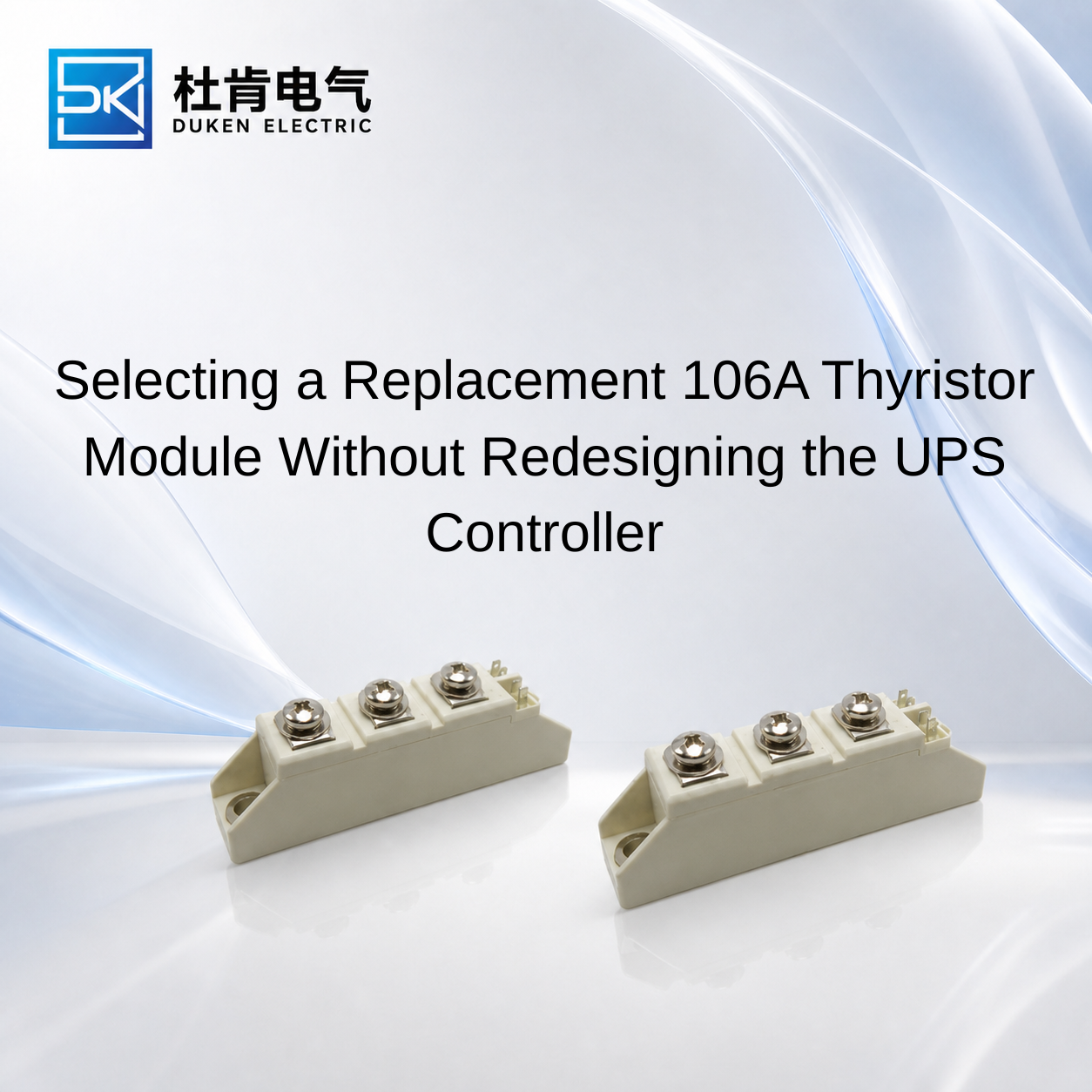
Selecting a Replacement 106A Thyristor Module Without Redesigning the UPS Controller
For UPS manufacturers maintaining an established product platform, changing the power semiconductor should ideally not require redesigning the entire control board. This makes Compatible driver circuits and controllers for thyristor modules a major consideration when qualifying a second-source or replacement 106A SCR. Matching current and blocking voltage is only the beginning. The new module must also work with the existing gate pulse, phase-control strategy, protection circuit, mechanical assembly, and cooling system. A replacement that appears electrically stronger can still create field problems if its trigger characteristics or thermal behavior differ significantly from the original device.
Establishing Electrical Compatibility with the Existing Controller
When an existing UPS has already accumulated years of reliable field operation, preserving the original controller can reduce development cost and qualification risk. However, this approach requires engineers to define exactly what the existing gate circuit expects from the thyristor.
IGT and VGT are among the first parameters to compare. IGT specifies the gate trigger current under defined test conditions, while VGT describes gate trigger voltage behavior. A replacement module should be evaluated against the actual gate signal available from the controller.
The objective is not merely to reach the published trigger threshold. Adequate operating margin should remain for temperature changes, component tolerances, production variation, isolation-device behavior, and wiring losses.
Gate terminal arrangement must also be checked carefully. A replacement with a similar housing does not necessarily use identical gate and cathode connections. Before describing a module as pin-compatible, engineers should compare the internal circuit diagram, terminal identification, and mechanical drawing.
This is particularly important when evaluating Compatible driver circuits and controllers for thyristor modules across different manufacturers. Current and voltage ratings are relatively easy to compare, but gate-drive compatibility can be overlooked during purchasing.
Phase-control timing should then be considered. In a controlled rectifier or AC control circuit, the controller synchronizes firing with the AC waveform. A reliable replacement should trigger consistently at the commanded firing point without requiring excessive changes to the established control strategy.
If the replacement requires substantially different gate conditions, the engineering team must decide whether modifying the controller is justified or whether another SCR is a better second-source candidate.
Evaluating Surge-Protection Low Forward-Voltage Phase-Angle-Control 106A Thyristor Modules for UPS Systems
A surge-protection low forward-voltage phase-angle-control 106A thyristor module for ups systems can be attractive as a replacement because both conduction loss and transient capability matter in industrial UPS equipment.
On-state voltage VT contributes directly to power dissipation while the SCR conducts. A useful approximation is:
Pcond ≈ VT × IT(avg)
If two modules operate at comparable current and temperature conditions, a lower VT can help reduce conduction loss. This can improve thermal margin, particularly in equipment where heat-sink and airflow capacity are already constrained.
However, datasheet values should be compared under similar conditions. A lower headline VT measured at a different current or temperature should not automatically be interpreted as superior application performance.
Surge performance requires separate analysis. ITSM describes specified non-repetitive surge on-state current capability. I²t can additionally help engineers coordinate the semiconductor with appropriate short-circuit protection.
For a surge-protection low forward-voltage phase-angle-control 106A thyristor module for ups systems, these ratings should be compared with the original module and the expected fault environment.
A replacement with higher ITSM may provide additional transient margin, but it does not eliminate the need for system-level protection. Semiconductor fuses, transient suppression, circuit impedance, and protection response remain important.
dv/dt and di/dt should also be checked. High dv/dt while the SCR is blocking can contribute to unintended triggering, while excessive current rise during turn-on can stress the device before conduction spreads adequately through the junction.
These characteristics matter because a replacement should work with the existing UPS protection and control architecture rather than forcing engineers to redesign surrounding circuits simply to accommodate the new semiconductor.
Mechanical and Thermal Matching for Screw-Mount Low-Rth(j-c) Modules
Mechanical compatibility is often underestimated in second-source qualification.
A screw-mount certified low Rth(j-c) 106A thyristor module for ups systems may appear convenient because screw-mounted modules are commonly integrated with heat sinks and busbar assemblies. Yet differences in footprint, mounting-hole position, terminal height, terminal orientation, and cooling-surface dimensions can complicate an otherwise straightforward replacement.
The dimensional drawing should therefore be checked before samples are ordered for production qualification.
Thermal resistance deserves equal attention. Rth(j-c) represents the thermal path between semiconductor junction and module case. The relationship can be expressed approximately as:
Tj = Tc + P × Rth(j-c)
Lower Rth(j-c) can reduce junction-to-case temperature rise for the same semiconductor loss. It does not, however, guarantee satisfactory system temperature.
Heat must continue through the module interface into the heat sink and then into the surrounding environment. Thermal-interface condition, heat-sink geometry, airflow, fan performance, and ambient temperature all influence the final junction temperature.
A screw-mount certified low Rth(j-c) 106A thyristor module for ups systems should therefore be tested using the intended mechanical and cooling arrangement.
Mounting should follow the module manufacturer's specified procedure. Applying an assumed universal screw torque is inappropriate because mechanical requirements can vary by package and manufacturer.
Certification claims should also be verified. If a procurement specification requires a particular certification, the supplier should provide documentation showing what has actually been certified rather than relying on a product description alone.
Thermal-Cycle Resistance in Long-Life UPS Replacement Projects
A second-source component may remain installed for years, so initial electrical performance is only one part of qualification.
An A46-version full-module thermal-cycle-resistant 106A thyristor module for ups systems may be relevant where the UPS repeatedly experiences changing power levels. Semiconductor temperature can rise during heavy loading and fall during standby or reduced-load operation, creating repeated thermal cycles.
These cycles matter because semiconductor modules contain several materials and interfaces. Repeated expansion and contraction can place mechanical stress on the internal assembly over time.
The A46 designation itself should be confirmed from the relevant manufacturer's documentation because version terminology is not necessarily standardized across suppliers.
For an A46-version full-module thermal-cycle-resistant 106A thyristor module for ups systems, procurement teams should look beyond the description and evaluate whether available technical information supports the intended application.
The relationship between thermal cycling and controller compatibility should not be overlooked either.
Gate trigger characteristics can vary with operating temperature. A replacement that triggers reliably during a short room-temperature test should therefore also be evaluated under representative thermal conditions.
For OEM qualification, staged testing is preferable to immediately approving a replacement after a basic functional check. Engineers can begin by verifying mechanical installation and static electrical characteristics, then confirm gate triggering and low-load operation before progressing to representative load and thermal operation.
This approach helps identify compatibility problems before the module enters volume production.
Replacement SCR, IGBT or Diode: Which Requires the Least Redesign?
When a 106A thyristor becomes difficult to source, buyers may consider related power semiconductor technologies. The alternatives, however, are not equally compatible with an existing SCR controller.
A conventional rectifier diode requires no gate signal. It provides uncontrolled conduction according to circuit polarity. Therefore, it cannot directly replace an SCR where firing-angle control is required.
An IGBT provides both active turn-on and active turn-off. This makes it highly suitable for high-frequency PWM conversion, but the gate driver and power-stage architecture differ substantially from SCR phase control.
IGBT switching losses also become an important design factor:
Psw ≈ Esw × fs
A conversion from SCR to IGBT may require changes to gate driving, protection, filtering, control logic, switching-frequency management, and electromagnetic compatibility.
MOSFETs similarly require active gate control and are selected according to different voltage, current, switching, and conduction-loss requirements.
For an existing line-frequency UPS circuit, a properly selected replacement SCR will often require fewer system changes than moving to another semiconductor technology.
This is why Compatible driver circuits and controllers for thyristor modules should be considered early in replacement sourcing. Preserving a proven gate controller can reduce redesign effort, but only when the replacement SCR has genuinely compatible electrical, thermal, and mechanical characteristics.
Conclusion
Replacing a 106A UPS thyristor without redesigning the existing controller is possible when qualification is performed at system level rather than by model number alone.
Engineers should compare IGT, VGT, VDRM/VRRM, VT, ITSM, I²t, dv/dt, di/dt, Rth(j-c), internal topology, terminal arrangement, and package dimensions. Gate triggering should be verified across representative operating conditions, while thermal testing should use the intended heat sink and cooling architecture.
Low forward voltage, low Rth(j-c), improved surge capability, and thermal-cycle-resistant construction can all strengthen a replacement candidate. None of these features, however, compensates for incompatible gate requirements or incorrect topology.
For industrial UPS manufacturers, the most practical second-source solution is usually the module that achieves the required reliability while preserving as much of the proven controller, protection circuit, cooling system, and mechanical assembly as possible.
FAQ
Q1: Can two 106A thyristor modules use the same controller?
Possibly, but current rating alone is insufficient. IGT, VGT, gate connections, topology, firing requirements, and temperature behavior should be compared.
Q2: Is lower VT always better for a replacement SCR?
Lower VT can reduce conduction loss when values are compared under equivalent conditions, but blocking, surge, gate, thermal, and mechanical characteristics must also match.
Q3: Why is Rth(j-c) important when replacing a UPS thyristor?
It affects the junction-to-case temperature rise for a given amount of semiconductor power loss and therefore contributes to thermal margin.
Q4: Should a replacement module be tested at full load immediately?
A staged qualification is generally more useful. Mechanical and electrical checks can be followed by gate-trigger, low-load, representative-load, thermal, and protection verification.
Q5: Can an IGBT replace an obsolete SCR without changing the controller?
Generally not. IGBTs require active turn-on and turn-off and typically involve different gate drivers, protection methods, switching strategies, and converter design.
READ MORE:
Procurement Guide to Low-Forward-Voltage 200A 400V Fast Recovery Diodes for Industrial Drives
Replacement Guide for Low-VF 200A 400V Fast Recovery Diodes in Industrial Inverters
Thermal Design Strategies for Low-VF 200A 400V Fast Recovery Diodes in Motor Drives
Low Qrr vs Low Forward Voltage: Selecting a 200A 400V Fast Recovery Diode for Frequency Inverters
Why Low Forward Voltage Matters in 200A 400V Fast Recovery Diodes
Controller Selection and Procurement Guide for 106A Thyristor Modules in UPS Systems
Thermal-Cycle Reliability and Driver Matching for 106A Thyristor Modules in UPS Systems
Phase-Angle Controller Design for 106A Thyristor Modules in Industrial UPS Systems
How to Match Driver Circuits with 106A Thyristor Modules in UPS Systems