
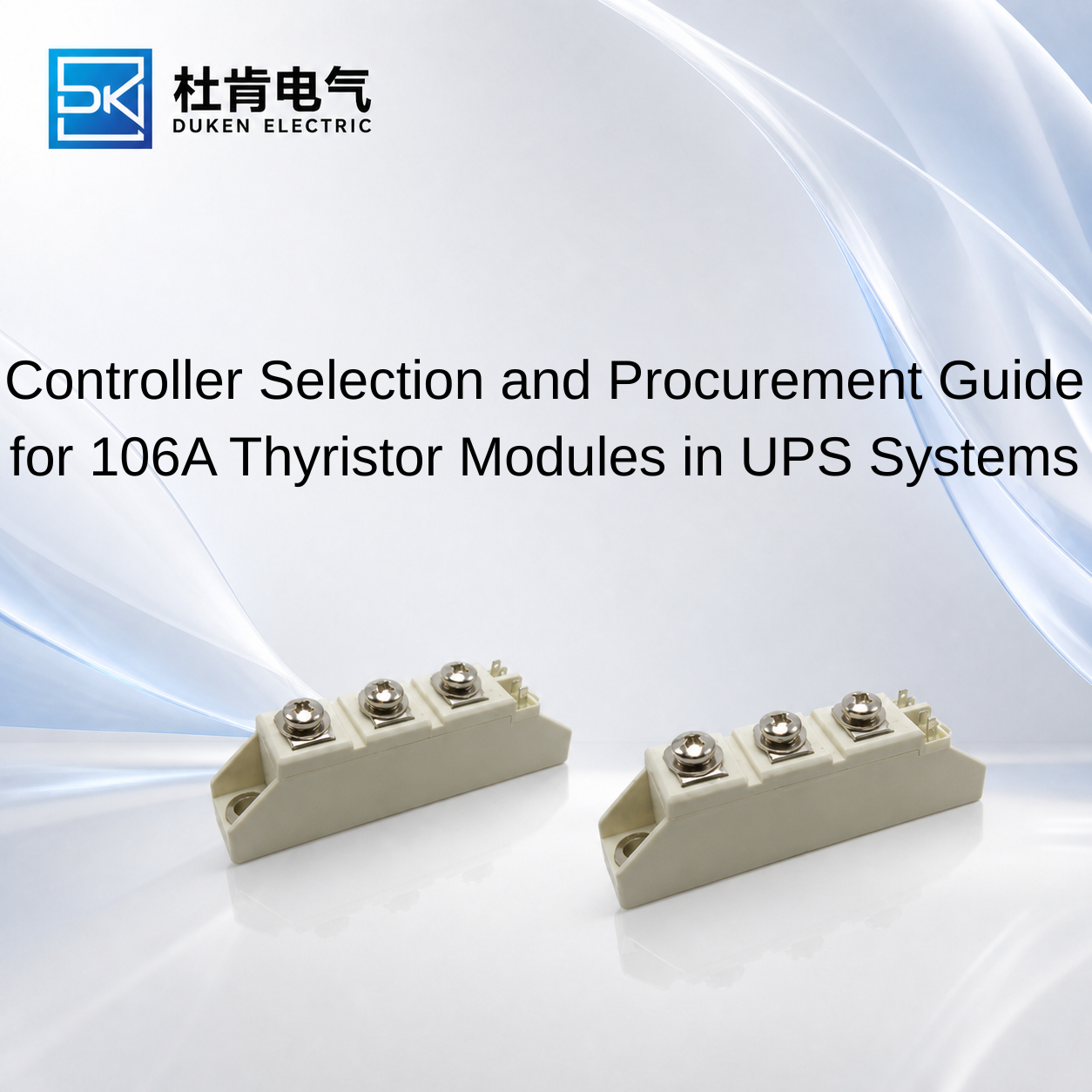
Controller Selection and Procurement Guide for 106A Thyristor Modules in UPS Systems
For industrial UPS manufacturers, selecting Compatible driver circuits and controllers for thyristor modules is not simply an electronic design decision. It also affects replacement flexibility, supplier qualification, maintenance cost, and long-term component availability. A 106A SCR module with suitable current and voltage ratings may still be unsuitable if its gate requirements cannot be supported by the existing controller. At the same time, characteristics such as low forward voltage, surge capability, thermal-cycle resistance, and low Rth(j-c) influence whether the module can operate reliably for years. A good procurement specification therefore connects semiconductor parameters with controller, protection, cooling, and mechanical requirements.
Building a Procurement Specification Around the Driver Circuit
When purchasing replacement thyristor modules, many buyers begin with a familiar model number. This is convenient, but it can create unnecessary dependence on a single supplier. A more sustainable approach is to define the electrical and mechanical characteristics that the UPS actually requires.
The controller provides an important starting point.
IGT and VGT describe fundamental gate-trigger characteristics. The existing controller must be capable of delivering an appropriate gate signal with sufficient margin under the intended operating conditions. Engineers should not assume that every module rated at 106A has identical triggering requirements.
The internal circuit configuration is equally important. Dual-thyristor modules can use different topologies, and identical package dimensions do not prove that their internal electrical connections are the same. Gate and cathode terminals should be mapped against the existing controller before a replacement is approved.
For phase-controlled applications, synchronization and firing timing must also be considered. The controller determines when the SCR begins conducting during the applicable AC half-cycle, so reliable timing is essential to achieving the intended controlled output.
These factors make Compatible driver circuits and controllers for thyristor modules a useful foundation for second-source qualification. Instead of asking only whether another manufacturer has “the same 106A module,” procurement teams can ask whether the candidate satisfies the actual gate, power-stage, mechanical, and thermal requirements of the UPS.
Blocking voltage should then be checked through VDRM and VRRM, while IT(AV) or the relevant current rating must be interpreted according to its specified waveform and thermal conditions. A current rating without those conditions provides an incomplete basis for comparison.
Balancing Low Forward Voltage and Surge Capability
A surge-protection low forward-voltage phase-angle-control 106A thyristor module for ups systems may be attractive to OEM buyers because both normal operating loss and abnormal current capability affect long-term reliability.
During conduction, the voltage across the SCR creates heat. A simplified estimate is:
Pcond ≈ VT × IT(avg)
For a device operating at substantial current, differences in VT can influence total semiconductor dissipation. Lower conduction loss can provide additional thermal margin, especially when cabinet airflow or heat-sink capacity is limited.
However, buyers should compare forward-voltage characteristics at similar current and temperature conditions. Datasheet headline values measured under different conditions should not be treated as directly equivalent.
Surge current requires another comparison.
ITSM indicates specified non-repetitive surge on-state current capability. It is useful when evaluating how a module may respond to short-duration abnormal current, but it must not be interpreted as a repetitive operating-current rating.
I²t can also help engineers evaluate fault-energy coordination with semiconductor protection.
A surge-protection low forward-voltage phase-angle-control 106A thyristor module for ups systems should therefore be purchased as part of a coordinated protection design. Semiconductor fuses, system impedance, transient suppression, and control response may all influence the stress applied to the SCR during a fault.
For phase-angle-controlled UPS circuits, gate timing should remain predictable during normal supply variation. The module's dv/dt and di/dt capabilities should also be evaluated because voltage transients and rapid current rise can create stresses that are not visible from the nominal 106A rating.
Procurement specifications that include these parameters make technical comparison between suppliers considerably more meaningful.
Using Thermal Performance to Compare A46 and Low-Rth(j-c) Options
Thermal performance is particularly important when a replacement module must operate in an existing UPS cabinet without changes to the heat sink or airflow system.
An A46-version full-module thermal-cycle-resistant 106A thyristor module for ups systems may be considered when repeated heating and cooling form an important part of the application duty cycle.
UPS equipment does not always operate at constant power. Charging, normal operation, standby, bypass, startup, and changing load can produce different semiconductor losses. As a result, module temperature may rise and fall repeatedly over its service life.
Thermal-cycle resistance can therefore be relevant to long-term reliability. However, “A46-version” should be treated as a manufacturer-specific designation unless supporting documentation defines it more precisely. Buyers should not assume that the name represents a universal qualification standard.
When evaluating an A46-version full-module thermal-cycle-resistant 106A thyristor module for ups systems, procurement managers should request the corresponding technical documentation and confirm that its electrical ratings remain compatible with the existing controller.
A different thermal option is a screw-mount certified low Rth(j-c) 106A thyristor module for ups systems.
Rth(j-c) describes thermal resistance from the semiconductor junction to the module case. For a simplified thermal estimate:
Tj = Tc + P × Rth(j-c)
Lower Rth(j-c) can reduce the junction-to-case temperature rise for a given level of semiconductor loss. Yet this does not describe the complete cooling system.
Thermal-interface quality, heat-sink design, airflow, fan condition, and ambient temperature remain important. A module with excellent internal thermal resistance can still overheat when installed on an inadequate heat sink.
For a screw-mount certified low Rth(j-c) 106A thyristor module for ups systems, dimensions and mounting instructions should therefore be reviewed together with thermal data. The supplier's specified mounting procedure should be followed rather than applying a generic torque value.
If certification is a purchasing requirement, the buyer should also request evidence identifying the applicable certification.
Comparing Replacement Options Without Over-Specifying the SCR
Procurement teams sometimes respond to reliability concerns by specifying the highest available value for every parameter. This can increase cost without necessarily improving UPS performance.
For example, moving from a 106A SCR to a significantly higher-current module does not automatically produce a better design. The larger device may have different gate requirements, VT characteristics, thermal behavior, footprint, terminals, or mounting requirements.
A better approach is to establish sufficient engineering margin for the real application.
The same principle applies to dv/dt and surge ratings. Higher capability can be beneficial, but the underlying cause of field failures should first be understood. If failures originate from poor cooling, selecting a dramatically higher surge rating may not solve the problem.
Technology changes should also be approached carefully.
IGBT modules are attractive for high-frequency PWM applications because the gate actively controls turn-on and turn-off. However, an IGBT driver is fundamentally different from an SCR phase-angle controller. Changing technology can require a new control strategy, protection circuit, switching-loss analysis, filtering, and electromagnetic design.
Rectifier diodes require no gate controller and are useful for uncontrolled rectification. They cannot directly provide the controlled firing function of an SCR.
MOSFETs similarly support active high-frequency switching and require a driver designed around their gate characteristics.
For an established line-frequency UPS platform, retaining a suitable SCR often offers the most economical route when the objective is component replacement rather than converter redesign.
Qualifying the Supplier as Well as the Thyristor Module
Technical parameters define whether a module can work. Supplier consistency determines whether it can remain a dependable production component.
After identifying Compatible driver circuits and controllers for thyristor modules, an OEM should establish a qualification process for alternative suppliers.
Initial evaluation can begin with documentation. Datasheets, dimensional drawings, internal circuit diagrams, compliance information, and relevant test documentation should be reviewed before volume purchasing.
Samples should then be tested with the intended controller.
Static electrical checks can establish basic blocking, conduction, and gate behavior. Functional testing can confirm firing with the existing driver, followed by representative load operation and thermal evaluation.
For production sourcing, batch consistency becomes particularly important. OEMs and distributors may need traceability that allows a component to be linked to its production batch if a field issue appears later.
Change control is another useful consideration. If the supplier modifies internal materials, manufacturing processes, or important electrical characteristics, the customer may need to evaluate whether requalification is necessary.
Price should therefore not be separated from technical risk.
A lower-cost module that requires controller redesign, heat-sink modification, repeated troubleshooting, or inconsistent incoming inspection can ultimately cost more than a properly qualified alternative.
For B2B procurement teams, total replacement effort is often a better decision criterion than component price alone.
Conclusion
Purchasing a 106A thyristor module for an industrial UPS requires coordination between engineering and procurement. Current and blocking-voltage ratings establish only the basic semiconductor class. Reliable sourcing additionally requires evaluation of IGT, VGT, VT, ITSM, I²t, dv/dt, di/dt, Rth(j-c), topology, mounting, terminals, and cooling conditions.
The controller is central to this process. A replacement SCR must trigger reliably with the existing gate circuit and remain stable throughout the intended temperature and load range.
Low forward voltage can reduce conduction loss, low Rth(j-c) can improve the internal thermal path, and appropriate surge capability can provide useful fault margin. Thermal-cycle-resistant construction may also benefit demanding UPS duty cycles. Each feature, however, should be supported by relevant technical documentation and evaluated within the complete system.
For manufacturers, distributors, and procurement managers, selecting Compatible driver circuits and controllers for thyristor modules together with qualified semiconductor alternatives creates a stronger long-term sourcing strategy. It reduces dependence on one model while helping preserve the proven controller and power-stage architecture of existing UPS equipment.
FAQ
Q1: What information should a buyer provide when sourcing a replacement 106A SCR module?
Providing the original model, datasheet, internal topology, blocking voltage, current requirements, gate characteristics, dimensions, cooling method, and application information makes replacement evaluation more reliable.
Q2: Should the replacement SCR have the highest possible ITSM?
Not necessarily. ITSM should provide suitable surge capability for the application and protection design. A higher number alone does not guarantee better overall compatibility.
Q3: Why should IGT and VGT be included in a procurement comparison?
They influence whether the existing controller can trigger the replacement module reliably without gate-circuit modification.
Q4: Is low Rth(j-c) more important than low VT?
They address different parts of thermal performance. VT influences conduction loss, while Rth(j-c) influences how effectively heat moves from the junction to the case. Both can be relevant.
Q5: What makes a second-source thyristor suitable for long-term UPS production?
Electrical and mechanical compatibility, repeatable quality, traceability, stable specifications, technical documentation, and successful application testing are all important.
READ MORE:
Procurement Guide to Low-Forward-Voltage 200A 400V Fast Recovery Diodes for Industrial Drives
Replacement Guide for Low-VF 200A 400V Fast Recovery Diodes in Industrial Inverters
Thermal Design Strategies for Low-VF 200A 400V Fast Recovery Diodes in Motor Drives
Low Qrr vs Low Forward Voltage: Selecting a 200A 400V Fast Recovery Diode for Frequency Inverters
Why Low Forward Voltage Matters in 200A 400V Fast Recovery Diodes
Selecting a Replacement 106A Thyristor Module Without Redesigning the UPS Controller
Thermal-Cycle Reliability and Driver Matching for 106A Thyristor Modules in UPS Systems
Phase-Angle Controller Design for 106A Thyristor Modules in Industrial UPS Systems
How to Match Driver Circuits with 106A Thyristor Modules in UPS Systems