
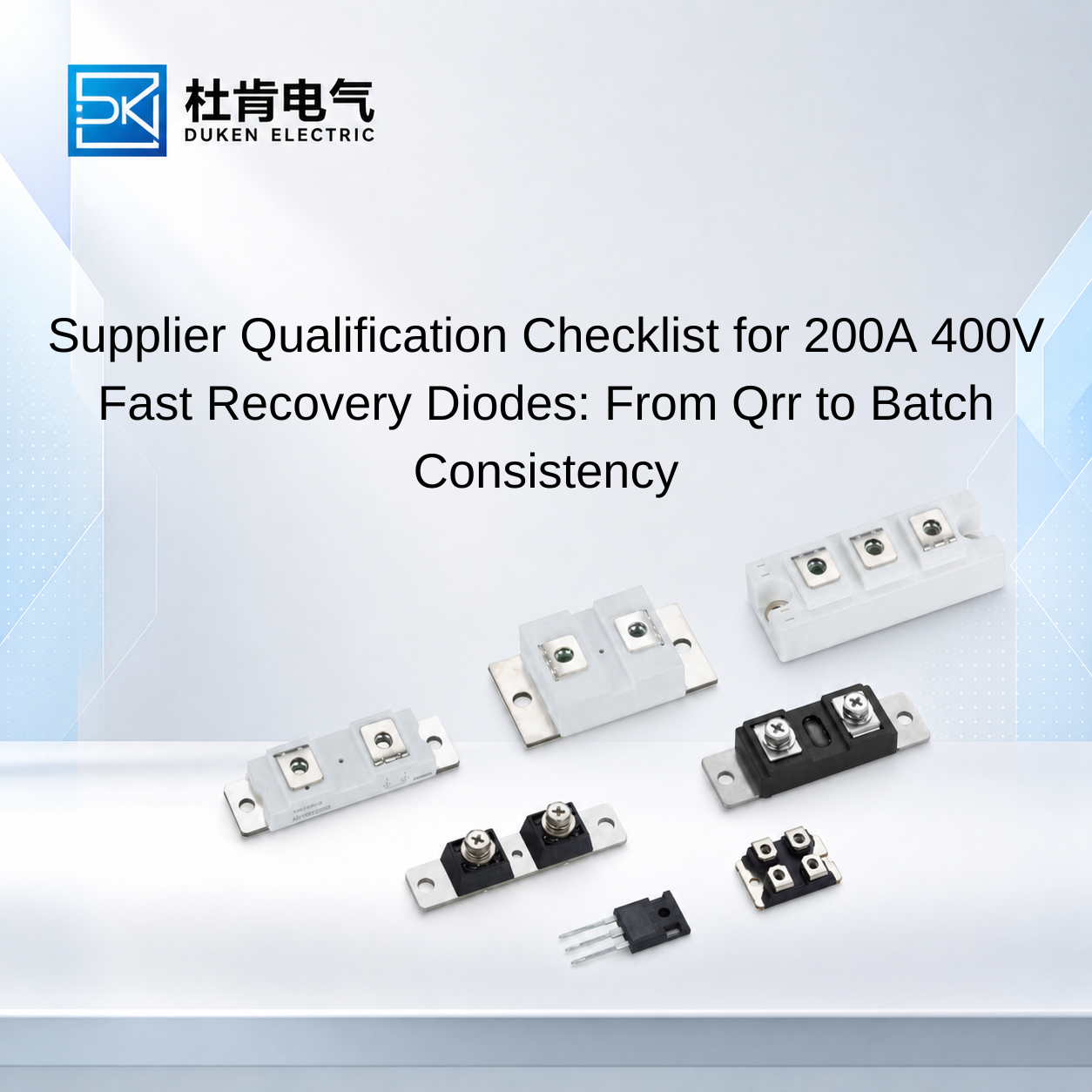
Supplier Qualification Checklist for 200A 400V Fast Recovery Diodes: From Qrr to Batch Consistency
Understanding Qrr in 200A 400V Fast Recovery Diodes: What Buyers Must Know becomes especially valuable when an industrial buyer moves from sample evaluation to bulk procurement. A diode may perform well during initial testing, but OEMs and distributors also need confidence that production batches will maintain comparable electrical, thermal, and mechanical characteristics. Qrr is an important part of this assessment because reverse recovery behavior can influence switching losses, IGBT stress, voltage overshoot, and converter temperature. However, professional supplier qualification should go beyond a single Qrr value and examine forward voltage, leakage current, surge capability, package consistency, traceability, test conditions, and application performance before a replacement diode enters regular production.
From Datasheet Approval to Real Supplier Qualification
The first stage of sourcing usually involves comparing datasheets. Buyers confirm that the candidate meets the required current and reverse-voltage class and then examine dynamic characteristics such as Qrr and trr.
For a silicon fast recovery diode, Qrr represents the reverse recovery charge that must be removed when the device transitions from forward conduction to reverse blocking:
Qrr = ∫ |iR(t)| dt
A lower value can be beneficial in switching applications, but the number has meaning only when its measurement conditions are understood.
Forward current, junction temperature, di/dt, and the recovery test circuit can influence the measured result. This creates an important procurement problem: two suppliers may publish different Qrr values without actually testing their devices under equivalent conditions.
Therefore, the lowest number on a datasheet should not automatically win the supplier comparison.
A more useful qualification process begins by confirming the test conditions and then comparing Qrr with trr, peak reverse recovery current, forward voltage, reverse leakage, thermal resistance, and applicable junction-temperature limits.
Surge capability should also be examined for industrial systems exposed to startup current, overloads, or fault conditions. ITSM or IFSM describes specified non-repetitive surge-current capability rather than continuous current capacity. I²t can provide additional information when engineers are coordinating semiconductor protection with fuses or other fault-protection devices.
This broader approach is central to Understanding Qrr in 200A 400V Fast Recovery Diodes: What Buyers Must Know because a reliable sourcing decision requires both dynamic and static electrical characteristics.
Sample approval should then verify the parameters that matter most in the actual equipment rather than simply repeating the manufacturer's datasheet tests.
Qualifying a Vishay Equivalent for Long-Term Production
When an OEM wants to qualify a brand Vishay equivalent glass-metal seal housing low conduction loss 200A 400V fast recovery diode, the objective is usually not merely to purchase one successful sample. The real objective is establishing a dependable second source.
That distinction changes the qualification process.
Current and voltage ratings should be checked first, followed by forward voltage. At high current, conduction loss can be significant:
Pcond ≈ VF × IF(avg)
If the replacement has substantially different VF, the heat generated during normal conduction may change even if the nominal current rating is identical.
Dynamic performance should then be compared. Qrr and trr influence switching behavior, particularly when the diode operates with an IGBT or MOSFET. Reverse leakage should also be evaluated under meaningful temperature and voltage conditions because leakage is strongly temperature dependent.
For a brand Vishay equivalent glass-metal seal housing low conduction loss 200A 400V fast recovery diode, mechanical similarity is also relevant. Housing dimensions, terminal geometry, polarity, and mounting requirements must be compatible with the existing equipment.
Once samples pass engineering tests, procurement teams should consider production consistency.
A replacement supplier should be able to maintain controlled product identification and manufacturing consistency between qualification samples and later deliveries. Depending on the importance of the application, buyers may establish incoming inspection for selected characteristics rather than assuming that one successful sample guarantees every future batch.
Traceability can also become valuable when products are used in industrial equipment with long service lives. If a field problem appears later, identifying the production lot can help engineering teams determine whether the issue is isolated or potentially associated with a wider batch.
The meaning of “equivalent” should therefore include repeatability, not simply initial compatibility.
Batch Consistency for 3/4″-16UNF Stud Type DO-9 Diodes
Mechanical consistency becomes particularly important for a 3/4″-16UNF stud type for bridge rectifier module stud mount DO-9 200A 400V fast recovery diode.
A buyer assembling hundreds of rectifiers needs each diode to fit the same mechanical structure. Variations in thread quality, terminal dimensions, package geometry, or polarity identification can create production problems even when electrical characteristics are acceptable.
The thermal interface also deserves attention because the stud package transfers heat into the mounting structure. Installation should follow the manufacturer's specified conditions, and the mounting surfaces should provide reliable thermal contact.
At 200A-class currents, poor heat transfer can reduce thermal margin and increase junction temperature.
For bridge rectifier applications, polarity consistency is especially important. Depending on the required circuit arrangement, buyers may need stud-anode and stud-cathode versions. Mixing configurations can create assembly errors or electrical faults.
A 3/4″-16UNF stud type for bridge rectifier module stud mount DO-9 200A 400V fast recovery diode should therefore be inspected not only as a semiconductor but also as a mechanical production component.
Electrical batch consistency matters as well.
If the diode is used in a conventional low-frequency bridge, VF and leakage may be more important to routine incoming inspection than extremely detailed Qrr characterization. In a faster switching circuit, dynamic characteristics deserve greater attention.
This demonstrates why incoming inspection should be application-specific. Testing every possible datasheet parameter may be unnecessary, while checking only appearance and model marking may be insufficient.
The buyer should identify which characteristics are critical to equipment performance and build the inspection plan around those risks.
Application Validation for High-Speed Industrial Power Converters
A high switching speed industrial power converter low reverse leakage current 200A 400V fast recovery diode requires a more demanding qualification process because the diode interacts dynamically with the switching transistor.
When an IGBT turns on, current may still flow through the recovering diode. The IGBT can temporarily carry load current plus reverse recovery current, increasing its switching stress.
Parasitic inductance can convert rapid current transitions into voltage overshoot:
V = L × di/dt
The resulting waveform depends on the diode, transistor, gate resistance, busbar layout, snubber design, and circuit inductance.
For this reason, application validation should compare candidate diodes in the same converter rather than evaluating them only on a static test bench.
A high switching speed industrial power converter low reverse leakage current 200A 400V fast recovery diode can be evaluated by observing recovery current, voltage overshoot, transistor switching behavior, and semiconductor temperature under representative loads.
Testing should continue long enough for the thermal system to approach stable operating conditions. A device that works for several minutes at room temperature may behave differently after the converter, heat sink, and enclosure reach normal operating temperature.
Buyers sourcing for industrial OEM production should also consider whether samples from different manufacturing batches show similar application behavior. This becomes particularly important when a diode is being introduced as a long-term second source.
One good sample demonstrates feasibility. Repeated performance across controlled production lots provides much stronger evidence of supply reliability.
Choosing a Long-Term Technology: Silicon FRD Versus SiC
Supplier qualification is also an opportunity to determine whether the existing diode technology remains appropriate.
Standard silicon rectifier diodes are still effective for many line-frequency systems. Their mature manufacturing, strong high-current capability, surge performance, and competitive cost make them practical where fast switching is not required.
Silicon FRDs provide improved recovery performance for switched power electronics and remain widely suitable for industrial converters requiring high current and established mechanical packages.
SiC Schottky diodes provide very low minority-carrier reverse recovery and can reduce recovery-related switching stress substantially in high-frequency applications. For new converter platforms seeking greater efficiency or higher switching frequency, this can offer meaningful system-level advantages.
However, changing technology requires more than comparing Qrr.
Forward conduction behavior, surge capability, package availability, thermal design, mechanical integration, supply continuity, and cost must all be considered. A legacy rectifier designed around stud-mounted silicon components may gain little from a technology change if switching frequency is low.
For existing equipment, qualifying a reliable silicon FRD second source may therefore offer the best balance between technical risk and supply-chain flexibility. For new high-frequency designs, evaluating SiC alongside silicon FRDs may be worthwhile.
Technology selection should support the operating requirements and expected service life of the equipment rather than follow a single specification trend.
Conclusion
Understanding Qrr in 200A 400V Fast Recovery Diodes: What Buyers Must Know becomes most useful when it is integrated into a complete supplier qualification process.
For industrial buyers, the goal is not simply to find a diode with 200A current capacity, 400V blocking capability, and an attractive Qrr value. The component must provide appropriate forward conduction, recovery behavior, leakage performance, thermal characteristics, surge capability, mechanical compatibility, and production consistency.
Initial samples should be compared with the existing device under representative electrical and thermal conditions. For bulk procurement, buyers should then consider incoming inspection, batch consistency, product identification, and traceability according to the importance of the application.
This approach reduces the risk of approving a replacement based on one successful sample or one attractive datasheet specification. For OEMs, distributors, and industrial equipment manufacturers, a technically qualified and consistently manufactured diode provides far greater long-term value than simply selecting the lowest Qrr or lowest purchase price.
FAQ
Q1: Is one successful diode sample enough to approve a new supplier?
Not necessarily. A sample can demonstrate initial compatibility, but critical industrial applications may also require evaluation of batch consistency and production traceability.
Q2: Which parameters should be checked besides Qrr?
Important parameters can include VF, trr, reverse leakage, thermal resistance, surge-current capability, junction-temperature limits, polarity, package dimensions, and mounting requirements.
Q3: What does “Vishay equivalent” mean for a replacement diode?
It should mean that the candidate has been evaluated for application compatibility. It does not imply that the component is an original Vishay product or that every specification is identical.
Q4: Should incoming inspection include Qrr testing?
It depends on the application and quality plan. In high-frequency switching equipment, dynamic behavior may be critical. In lower-frequency rectification, other electrical and mechanical parameters may receive greater priority.
Q5: When is SiC worth considering instead of a silicon FRD?
SiC is particularly attractive when high switching frequency makes recovery-related losses important. The decision should still consider conduction loss, surge capability, package compatibility, thermal design, availability, and cost.
READ MORE:
From Emergency Stock to Long-Term Supply: Qualifying a 300A Phase Control Thyristor
Lead Time vs Technical Fit: Buying a 300A Phase Control Thyristor from Stock
Selecting an In-Stock 300A Phase Control Thyristor for High-Current Rectifier Systems
How In-Stock 300A Phase Control Thyristors Reduce Downtime in Industrial Power Systems
300A Phase Control Thyristor in Stock: What Industrial Buyers Should Verify Before Ordering
Thermal and Reliability Risks of Qrr in 200A 400V Fast Recovery Diodes
How to Evaluate Qrr, Irr and trr in 200A 400V Fast Recovery Diodes
How Qrr Influences Efficiency and Device Selection in 200A 400V Fast Recovery Diodes
Why Qrr Test Conditions Matter When Sourcing 200A 400V Fast Recovery Diodes