
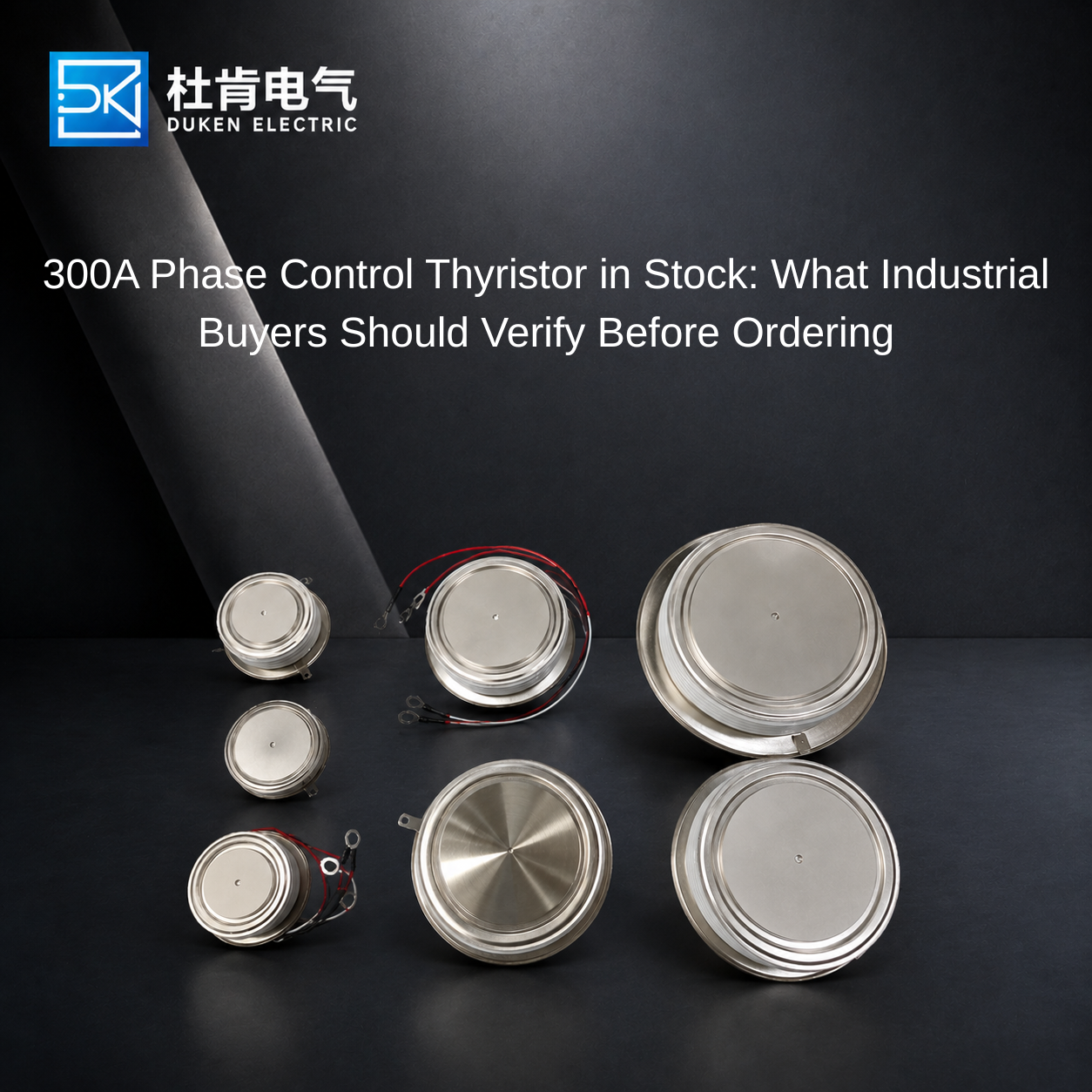
300A Phase Control Thyristor in Stock: What Industrial Buyers Should Verify Before Ordering
Finding a 300A phase control thyristor in stock can shorten procurement time when an industrial rectifier, AC controller, battery charger, or electro-chemical power system requires urgent production or replacement parts. However, stock availability should never replace technical verification. Two SCRs described as 300A devices may differ in repetitive blocking voltage, on-state voltage, surge capability, gate characteristics, thermal resistance, package construction, and required mounting conditions. For OEM engineers and purchasing managers, the right question is not simply “Is it available now?” but “Is the available device electrically, thermally, and mechanically suitable for my application?”
What Does “300A” Actually Mean When Selecting a Phase Control Thyristor?
The 300A description usually refers to a specified current rating under defined datasheet conditions. It should not be interpreted as a guarantee that the thyristor can continuously carry exactly 300A in every installation.
For a phase control SCR, engineers should first review the stated average on-state current, RMS current where applicable, repetitive peak off-state and reverse voltage ratings, and the conditions under which these values are specified. Case temperature, conduction angle, waveform, cooling, and mounting conditions can significantly influence usable current capability.
On-state voltage is particularly relevant to thermal design. A simplified first estimate of conduction loss can be expressed as:
Pcond ≈ VT × IT(avg)
At hundreds of amperes, conduction loss can create substantial heat. A stocked SCR with the correct nominal current but a different VT characteristic may therefore change heat-sink temperature and junction-temperature margin.
Thermal resistance from junction to case, Rth(j-c), should be evaluated together with expected power dissipation. A simplified thermal relationship is:
Tj = Tc + P × Rth(j-c)
This does not represent the entire cooling system because the thermal interface and heat sink must also be included, but it demonstrates why current rating cannot be separated from thermal design.
Blocking voltage is another critical selection parameter. Buyers should choose an appropriate VDRM/VRRM class according to the circuit voltage, transient environment, and design margin rather than simply selecting the highest available voltage.
When sourcing a 300A phase control thyristor in stock, procurement teams should therefore request the complete datasheet and confirm the operating conditions behind the current rating before approving a substitute.
High Thermal Stability for AC Load Voltage Regulation 300A Phase Control Thyristor
Phase control is one of the traditional strengths of SCR technology. Once triggered by a suitable gate pulse, a conventional SCR remains conducting until its current falls below the holding-current requirement, normally as the AC waveform approaches a natural current zero.
By adjusting the firing angle during each AC half-cycle, the controller changes how much of the waveform is delivered to the load. This makes thyristors practical for industrial heating control, soft starting, regulated AC supplies, and other line-frequency power-control systems.
A high thermal stability for AC load voltage regulation 300A phase control thyristor must perform reliably under repeated conduction cycles while maintaining sufficient junction-temperature margin.
Thermal stability does not come from current rating alone. It depends on on-state loss, thermal resistance, heat-sink performance, ambient temperature, airflow, mounting quality, and the actual load cycle.
Gate characteristics should also be checked carefully. IGT and VGT help engineers determine whether the existing trigger circuit can reliably turn on the candidate SCR. A replacement that requires substantially different gate drive may not behave correctly even if its main current and voltage ratings appear suitable.
dv/dt and di/dt capabilities also deserve attention. Rapid voltage changes can create unwanted turn-on risk, while excessive current rise immediately after triggering can create localized semiconductor stress. Appropriate gate-drive design, circuit layout, snubber arrangements where required, and application-specific protection remain important.
For a high thermal stability for AC load voltage regulation 300A phase control thyristor, the thermal design should be checked at the expected worst practical operating point rather than only at room temperature. Industrial cabinets may operate in elevated ambient temperatures, and cooling performance can deteriorate over time because of fan degradation, blocked airflow, or contamination.
Maintaining thermal margin is therefore more reliable than designing the SCR to operate continuously near its absolute maximum junction temperature.
High Surge Current Rating for Electro-Chemical Processing Equipment
Electro-chemical processes such as electroplating, electrolysis, and related high-current DC applications often use controlled rectifier systems to regulate output power. Phase control thyristors can be particularly suitable because they combine high current capability with controlled rectification at line frequency.
A high surge current rating for electro-chemical processing equipment 300A phase control thyristor should be evaluated not only for normal operating current but also for abnormal and transient conditions.
ITSM represents specified non-repetitive surge-current capability. It should not be confused with the normal continuous current rating. A high ITSM value indicates that the device can withstand a defined short-duration surge under the manufacturer's stated test conditions, but it does not mean the SCR can repeatedly operate at that current.
I²t is another useful parameter when coordinating semiconductor protection. It can help engineers evaluate the energy associated with short-duration overcurrent events and select suitable fast-acting protection devices.
In electro-chemical power supplies, load behavior, transformer characteristics, DC-side conditions, startup sequences, and possible faults can all influence current stress. A high surge current rating for electro-chemical processing equipment 300A phase control thyristor should therefore be selected as part of the complete rectifier protection design rather than from ITSM alone.
Cooling also becomes important because these systems may operate at high current for extended periods. A diode or thyristor that survives a short surge still requires adequate continuous thermal management during normal production.
For replacement projects, engineers should compare the candidate SCR with the original for IT(AV), voltage class, VT, ITSM, I²t, Rth(j-c), IGT/VGT, package dimensions, polarity, and mounting requirements.
This reduces the risk of selecting an available part that works during initial startup but lacks the required thermal or surge margin for long-term operation.
In-Stock SCR Versus Diode, IGBT and Other Power Semiconductor Options
Availability sometimes encourages buyers to consider a different semiconductor technology. However, replacement should be based on circuit function rather than stock status.
A rectifier diode is an uncontrolled device. Once circuit conditions forward-bias it, conduction occurs without a gate signal. It can therefore perform industrial rectification efficiently but cannot provide the firing-angle control available from an SCR.
A phase control thyristor adds controllability. Its gate determines when conduction begins during the applicable cycle, while current commutation determines when a conventional SCR turns off. This makes SCRs well suited to line-frequency controlled rectifiers and AC power controllers.
An IGBT provides active gate-controlled turn-on and turn-off and is therefore much more suitable for high-frequency PWM converters. However, an IGBT should not be considered a direct drop-in substitute for a phase control SCR. The gate-drive architecture, switching strategy, protection circuit, losses, and overall topology are different.
This is important when a maintenance department urgently needs a 300A phase control thyristor in stock. Changing from SCR technology to IGBT simply because an IGBT is readily available can require substantial circuit redesign.
For existing industrial rectifiers and AC controllers, a properly matched phase control thyristor is usually the lower-risk replacement path. For a new converter requiring high-frequency PWM, an IGBT or another actively controlled switching technology may be more appropriate.
The application should determine the technology—not the warehouse inventory.
How Buyers Should Verify Stock Before Placing a Bulk Order
“In stock” can mean different things across the semiconductor supply chain. For industrial buyers, it is useful to distinguish between actual finished-product inventory, available components awaiting assembly, and material that can be produced quickly.
This distinction matters when delivery time is critical.
Before ordering, buyers should confirm the exact model, voltage class, package, quantity available, marking requirements, and whether the quoted stock belongs to the same specification being evaluated.
For OEM production, batch consistency is also important. A small sample lot may meet the electrical requirements, but a larger production order should maintain consistent device structure and relevant electrical characteristics.
Replacement projects deserve additional caution. Mechanical dimensions, mounting configuration, terminal arrangement, and required clamping or mounting conditions should be checked against the original product. For disc or press-pack thyristors, the manufacturer's specified clamping force and cooling requirements must be followed.
Sample testing is particularly valuable when introducing a new supplier. Engineers can evaluate gate triggering, on-state behavior, blocking characteristics, operating temperature, and performance under representative load conditions.
For AC phase controllers, testing should reproduce the intended firing-angle range and thermal conditions. For electro-chemical rectifiers, engineers should also consider high-current operation and realistic transient conditions.
Stock availability is valuable only when the available product is technically qualified.
Conclusion
A 300A phase control thyristor in stock can help industrial buyers reduce replacement downtime and shorten production lead times, but availability should be treated as one part of the sourcing decision rather than the primary technical criterion.
Current rating must be interpreted together with its datasheet conditions. VDRM/VRRM, VT, ITSM, I²t, Rth(j-c), IGT/VGT, dv/dt, di/dt, package design, and mounting requirements can all influence whether a particular SCR is suitable for an existing system.
Applications also create different priorities. AC load voltage regulation places strong emphasis on controlled triggering and thermal stability, while electro-chemical processing equipment may require careful evaluation of continuous high-current operation, surge capability, cooling, and protection coordination.
For OEMs, distributors, and maintenance engineers, the most reliable procurement approach is to combine verified inventory with complete datasheet comparison and representative sample testing. The best in-stock thyristor is not simply the part that can ship today—it is the part that can meet the electrical, thermal, mechanical, and reliability requirements of the equipment after installation.
FAQ
Q1: Does a 300A thyristor always carry 300A continuously?
No. The current rating is specified under defined waveform, temperature, conduction, cooling, and mounting conditions. The datasheet conditions must be reviewed.
Q2: Which parameters should buyers check besides current and voltage?
Important parameters include VT, ITSM, I²t, Rth(j-c), IGT/VGT, dv/dt, di/dt, junction-temperature limits, package dimensions, and mounting requirements.
Q3: Why is surge-current capability important in electro-chemical equipment?
High-current rectifier systems can experience startup, overload, or fault transients. ITSM and I²t help engineers evaluate short-duration current capability and protection coordination.
Q4: Can an IGBT directly replace a 300A phase control thyristor?
Usually not. IGBTs use active turn-on and turn-off and are suited to different switching strategies. Replacing an SCR with an IGBT normally requires circuit and gate-drive redesign.
Q5: What should buyers confirm when a supplier says a thyristor is in stock?
Confirm the exact model, voltage rating, package, available quantity, datasheet revision or specification, marking, delivery time, and whether samples are available for qualification.
READ MORE:
From Emergency Stock to Long-Term Supply: Qualifying a 300A Phase Control Thyristor
Lead Time vs Technical Fit: Buying a 300A Phase Control Thyristor from Stock
Selecting an In-Stock 300A Phase Control Thyristor for High-Current Rectifier Systems
How In-Stock 300A Phase Control Thyristors Reduce Downtime in Industrial Power Systems
Supplier Qualification Checklist for 200A 400V Fast Recovery Diodes: From Qrr to Batch Consistency
Thermal and Reliability Risks of Qrr in 200A 400V Fast Recovery Diodes
How to Evaluate Qrr, Irr and trr in 200A 400V Fast Recovery Diodes
How Qrr Influences Efficiency and Device Selection in 200A 400V Fast Recovery Diodes
Why Qrr Test Conditions Matter When Sourcing 200A 400V Fast Recovery Diodes