
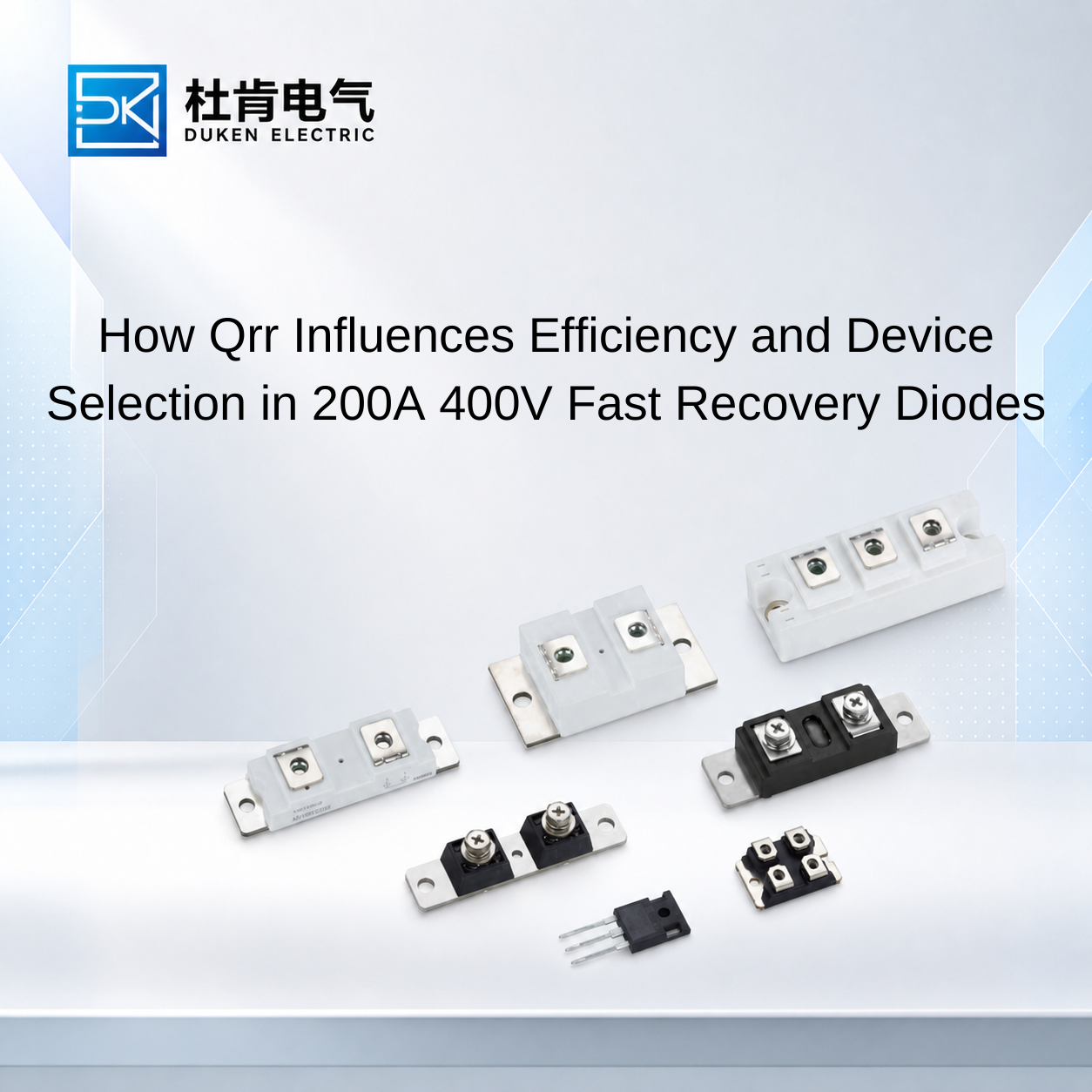
How Qrr Influences Efficiency and Device Selection in 200A 400V Fast Recovery Diodes
Understanding Qrr in 200A 400V Fast Recovery Diodes: What Buyers Must Know is essential when selecting diodes for industrial converters where efficiency, thermal performance, and long-term reliability are closely connected. A 200A 400V diode may appear suitable based on current and blocking voltage, yet its reverse recovery characteristics can significantly affect switching losses in welding inverters, UPS systems, motor drives, industrial DC converters, and other power electronics. Qrr, or reverse recovery charge, determines how much stored charge must be removed when a silicon PN diode changes from forward conduction to reverse blocking. For industrial buyers, understanding this parameter helps distinguish a genuinely suitable replacement from a component that simply shares the same headline electrical ratings.
How Qrr Contributes to Converter Power Loss
When a silicon fast recovery diode conducts forward current, minority carriers accumulate inside its semiconductor structure. When the applied voltage reverses, the diode cannot immediately stop conducting. The stored charge must first be removed, creating a short reverse-current interval.
The total charge involved during this recovery event is represented by Qrr:
Qrr = ∫ |iR(t)| dt
Reverse recovery time, or trr, describes how long the recovery event lasts, while Qrr represents the amount of charge involved. Peak reverse recovery current provides another important indication of the electrical stress generated during commutation.
For buyers, the distinction is important because a short trr does not necessarily mean that the diode produces the lowest switching loss.
The reverse recovery event also affects the switching transistor. In an IGBT-based converter, the transistor turning on may temporarily conduct the normal load current plus the recovery current from the diode. This increases current during the switching transition and can raise IGBT turn-on energy.
As switching frequency rises, the effect is repeated more frequently. Average switching-related loss can be approximated conceptually as:
Psw ≈ Esw × fs
where Esw represents switching energy per event and fs represents switching frequency.
This explains why Qrr may have limited impact in a low-frequency rectifier but become a major selection consideration in a high-frequency converter.
Temperature also affects recovery behavior. Therefore, Qrr measured under room-temperature laboratory conditions should not automatically be assumed to represent operation inside a hot industrial cabinet. Buyers should examine the manufacturer's stated test conditions and, for critical projects, evaluate samples at representative operating temperatures.
Selecting a Vishay Equivalent: Qrr Versus Low Conduction Loss
Second-source procurement often begins with an established diode model. Buyers may seek a brand Vishay equivalent glass-metal seal housing low conduction loss 200A 400V fast recovery diode because of cost, availability, lead-time, or supply-chain considerations.
The first step is confirming the basic blocking and current requirements. However, the next comparison should not focus on Qrr alone.
Forward voltage directly influences conduction loss:
Pcond ≈ VF × IF(avg)
At high current, this relationship becomes important. If a diode carries substantial average current, a higher VF can produce additional heat that must be removed by the package and heat sink.
This creates an engineering trade-off between conduction performance and switching performance.
In a converter operating at moderate switching frequency with long conduction intervals, VF may contribute more strongly to average semiconductor loss. In a faster converter, Qrr can become increasingly important because reverse recovery occurs thousands of times per second.
For this reason, a brand Vishay equivalent glass-metal seal housing low conduction loss 200A 400V fast recovery diode should be compared using a combination of VF, Qrr, trr, reverse leakage current, thermal resistance, surge capability, and junction-temperature limits.
Package construction also matters. A similar glass-metal seal housing can support mechanical replacement, but external similarity does not prove identical semiconductor behavior.
For OEM qualification, an “equivalent” should mean that the proposed device satisfies the application's electrical, thermal, mechanical, and dynamic requirements. It should not imply that the device is an original Vishay product or that every specification is identical.
A practical qualification test compares the original and candidate diode under the same load current, switching frequency, cooling arrangement, and ambient conditions. This allows engineers to evaluate total converter behavior rather than individual datasheet values.
Qrr Selection for High-Speed Industrial Power Converters
Qrr becomes particularly important when selecting a high switching speed industrial power converter low reverse leakage current 200A 400V fast recovery diode.
In an IGBT converter, the diode and transistor operate as an interacting switching pair. When the IGBT turns on, diode reverse recovery can temporarily increase transistor current. Higher Qrr can therefore contribute to greater turn-on stress and higher switching loss.
Circuit parasitic inductance adds another challenge:
V = L × di/dt
Rapid recovery-current changes interacting with busbar, package, cable, or PCB inductance can produce voltage overshoot and ringing. This can increase semiconductor stress and electromagnetic interference.
The solution is not simply to select the diode with the lowest published Qrr.
A very fast recovery characteristic must still work correctly with the converter's gate drive, snubber network, layout, switching device, and operating conditions. Engineers should consider the complete recovery waveform rather than using a single number as a universal quality ranking.
Reverse leakage current is also relevant. A high switching speed industrial power converter low reverse leakage current 200A 400V fast recovery diode must maintain suitable blocking performance, particularly when operating temperature rises.
Leakage generally increases with junction temperature. Buyers should therefore compare IR values at similar voltage and temperature conditions.
In applications such as welding inverters, industrial UPS systems, motor drives, induction heating equipment, and switched DC power supplies, the most useful qualification method is to observe diode current and voltage waveforms together with transistor behavior.
Case temperature and heat-sink temperature should also be monitored after the system reaches thermal equilibrium.
This reveals whether a lower-Qrr candidate actually produces a measurable improvement in system efficiency and thermal performance.
Does Qrr Matter for 3/4″-16UNF Stud Type DO-9 Diodes?
A 3/4″-16UNF stud type for bridge rectifier module stud mount DO-9 200A 400V fast recovery diode introduces another selection question: how much priority should Qrr receive compared with mechanical and thermal characteristics?
The answer depends on the circuit.
If the diode is used primarily for line-frequency rectification, it experiences relatively few recovery events compared with a high-frequency inverter. In that environment, VF, thermal resistance, surge-current capability, package reliability, and heat-sink installation may have a greater influence on performance.
If the same stud diode operates in a higher-frequency commutation circuit, Qrr becomes much more important.
This distinction is useful for procurement because it prevents over-specification. Purchasing the fastest possible diode does not necessarily create measurable value in a circuit where switching frequency is low.
Mechanical compatibility should also be confirmed carefully.
A 3/4″-16UNF stud type for bridge rectifier module stud mount DO-9 200A 400V fast recovery diode should be checked for overall package dimensions, thread specifications, terminal arrangement, and stud polarity.
Depending on the device configuration, the stud may correspond electrically to the anode or cathode. An incorrect polarity can make a physically compatible diode unsuitable for an existing bridge assembly.
Thermal mounting is equally important. The manufacturer's specified mounting conditions should be followed because the mechanical interface forms part of the heat-transfer path. A low-Qrr diode operating with poor thermal contact can still experience excessive junction temperature.
FRD Versus Standard Diode and SiC: Choosing by Application
Understanding Qrr in 200A 400V Fast Recovery Diodes: What Buyers Must Know also requires recognizing when fast recovery is genuinely necessary.
A conventional silicon rectifier diode remains a practical solution for line-frequency rectification. In these systems, low conduction loss, high current capability, surge performance, mature manufacturing, and cost can outweigh the benefit of very fast recovery.
A silicon FRD is more appropriate when faster commutation is required. It provides improved recovery characteristics while maintaining the high-current capabilities and established packages required by many industrial systems.
SiC Schottky diodes offer much lower minority-carrier reverse recovery than silicon PN fast recovery diodes. This can reduce switching loss and transistor turn-on stress significantly in higher-frequency power converters.
However, SiC is not automatically the best replacement for every 200A silicon FRD.
Engineers must still evaluate forward conduction characteristics, surge requirements, package availability, cooling, mechanical integration, switching frequency, and total system cost.
For legacy equipment, a compatible silicon FRD can often provide the lowest-risk replacement because it preserves the established electrical and mechanical architecture. For new high-frequency designs, SiC becomes increasingly attractive when reduced switching loss supports higher efficiency or greater power density.
Technology selection should therefore follow the converter's operating conditions rather than current industry trends alone.
Conclusion
Understanding Qrr in 200A 400V Fast Recovery Diodes: What Buyers Must Know requires looking beyond the assumption that lower Qrr automatically means a better diode.
Qrr influences reverse recovery current, switching loss, IGBT or MOSFET turn-on stress, voltage overshoot, and thermal performance. At the same time, forward voltage, leakage current, thermal resistance, surge capability, package construction, and mounting conditions remain essential selection parameters.
For industrial buyers, application frequency should determine how heavily Qrr is weighted. A line-frequency bridge rectifier may prioritize conduction and surge performance, while a high-frequency industrial converter requires much closer attention to recovery characteristics.
The strongest procurement strategy combines datasheet analysis with representative sample testing. Comparing original and replacement diodes under identical electrical and thermal conditions allows engineers to identify the component that provides the best overall balance of efficiency, reliability, mechanical compatibility, and supply availability rather than simply choosing the lowest published Qrr.
FAQ
Q1: Does lower Qrr always improve converter efficiency?
No. Lower Qrr can reduce recovery-related switching losses, but total efficiency also depends on VF, switching frequency, transistor losses, thermal conditions, and circuit design.
Q2: Why should VF and Qrr be evaluated together?
VF affects conduction loss while Qrr influences recovery-related switching behavior. Depending on the operating frequency and duty cycle, either loss mechanism can become significant.
Q3: Is Qrr important for a 50/60 Hz bridge rectifier?
Usually it is less important than in a high-frequency converter. Forward loss, surge capability, thermal resistance, and mechanical reliability may deserve greater priority.
Q4: Can two 200A 400V FRDs with similar trr have different Qrr?
Yes. trr describes recovery duration, while Qrr represents recovery charge. The recovery waveform and test conditions can result in different Qrr values even when trr appears similar.
Q5: When should buyers consider SiC instead of a silicon FRD?
SiC deserves consideration in higher-frequency converters where recovery-related losses significantly affect efficiency and thermal performance, provided its package, conduction, surge, cost, and system requirements are suitable.
READ MORE:
From Emergency Stock to Long-Term Supply: Qualifying a 300A Phase Control Thyristor
Lead Time vs Technical Fit: Buying a 300A Phase Control Thyristor from Stock
Selecting an In-Stock 300A Phase Control Thyristor for High-Current Rectifier Systems
How In-Stock 300A Phase Control Thyristors Reduce Downtime in Industrial Power Systems
300A Phase Control Thyristor in Stock: What Industrial Buyers Should Verify Before Ordering
Supplier Qualification Checklist for 200A 400V Fast Recovery Diodes: From Qrr to Batch Consistency
Thermal and Reliability Risks of Qrr in 200A 400V Fast Recovery Diodes
How to Evaluate Qrr, Irr and trr in 200A 400V Fast Recovery Diodes
Why Qrr Test Conditions Matter When Sourcing 200A 400V Fast Recovery Diodes