
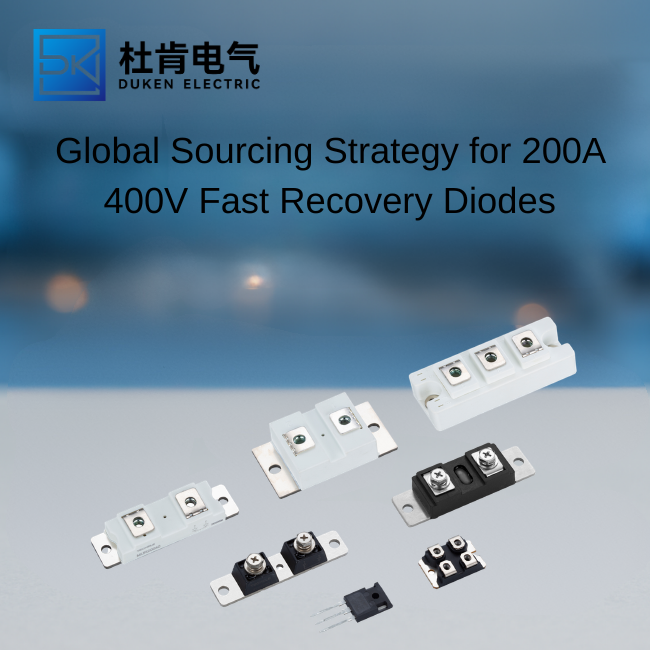
Global Sourcing Strategy for 200A 400V Fast Recovery Diodes
Author: Selina
Global sourcing of a 200A 400V fast recovery diode requires more than collecting quotations from multiple suppliers. For industrial OEMs, motor-drive manufacturers, welding equipment producers, solar inverter builders, and component distributors, the real objective is to secure a technically compatible, traceable, and consistently available device at a sustainable total cost.
A sourcing decision that appears economical at the purchase stage can become expensive if the diode requires redesign, creates switching losses, fails qualification, or becomes unavailable during production. A structured sourcing strategy should therefore combine engineering approval, supplier risk assessment, lifecycle planning, and inventory control.
Build a Technical Cross-Reference Before Comparing Prices
The comparison should include:
Repetitive peak reverse voltage
Average and RMS forward current
Non-repetitive surge current
Forward voltage at specified current
Reverse recovery time
Reverse recovery charge
Peak reverse recovery current
Recovery softness
Maximum junction temperature
Junction-to-case thermal resistance
Reverse leakage at elevated temperature
Package dimensions and polarity
Recovery values must be compared under similar test conditions. A lower trr number is not automatically better if it was measured at a lower current, lower junction temperature, or slower di/dt. Procurement teams should ask engineering to approve the data before treating two models as equivalent.
For a fast reverse recovery for bridge rectifier module for motor drive application 200A 400V fast recovery diode, the cross-reference must also consider the switching device, motor current, DC-link voltage, switching frequency, snubber network, and busbar inductance. The diode and IGBT or MOSFET should be evaluated as one switching system.
Select the Package According to Equipment Architecture
DO-9 Stud Mount for Rugged and Serviceable Designs
A for solar inverter stud mount DO-9 used in welding machine 200A 400V fast recovery diode may be suitable for heavy-duty converters, legacy industrial platforms, and equipment using large heat sinks and busbars.
Its strengths include a direct mechanical attachment, a short thermal path, compatibility with high-current conductors, and relatively straightforward field replacement. It can be particularly practical in welding systems where pulse current, rugged mounting, and serviceability are priorities.
However, the sourcing specification should define stud polarity, thread size, mounting torque, heat-sink finish, insulation method, and terminal-load limits. A dimensionally similar alternative can still create assembly problems if the thread, polarity, or terminal geometry differs.
SOT-227 for Compact Modular Equipment
A SOT-227 package automotive application high temperature 150°C 200A 400V fast recovery diode can support compact, modular power assemblies with screw terminals and, depending on the exact model, an isolated baseplate.
SOT-227 may simplify production because its footprint can be easier to standardize across several converter models. It is attractive for solar inverters, motor drives, and modular bridge assemblies where controlled creepage, repeatable torque, and shared heat sinks are important.
Buyers should verify whether the 150°C figure refers to maximum junction temperature or a validated continuous operating condition. They should also confirm automotive qualification separately. A package commonly used in automotive electronics is not automatically AEC-Q101 qualified.
Qualify the Supplier as Carefully as the Device
Supplier capability affects long-term performance and availability. A reliable source should provide a controlled datasheet, test conditions, mechanical drawings, RoHS and REACH declarations, batch traceability, and formal change-notification procedures.
Key supplier questions include:
Where is the diode wafer fabricated and assembled?
Are die sources fixed or subject to substitution?
What electrical tests are performed on every production lot?
Are recovery parameters sampled or fully tested?
How are date codes and lot numbers controlled?
What changes require customer notification?
How are failures analyzed and reported?
What is the standard lead time and safety-stock policy?
For critical programs, procurement teams should request samples from more than one production lot. This helps identify variation in forward voltage, leakage current, recovery charge, package dimensions, or terminal finish.
Counterfeit and Unauthorized Substitution Risk
High-current power semiconductors can be exposed to relabeling, reclaimed parts, and unauthorized die substitution. Warning signs include inconsistent labels, damaged terminals, mixed date codes, unusual packaging, missing traceability, or specifications copied from another manufacturer.
Incoming inspection should compare weight, dimensions, polarity marking, terminal finish, forward voltage, reverse leakage, and recovery behavior against an approved reference. High-risk purchases may justify X-ray inspection, curve tracing, or third-party laboratory analysis.
Use Total Cost of Ownership, Not Unit Price Alone
The lowest quotation may not provide the lowest total cost. Buyers should include engineering validation, heat-sink changes, mounting hardware, assembly time, energy loss, inventory, warranty exposure, and downtime risk.
A diode with lower forward voltage and recovery charge may reduce heat and switching loss. Over thousands of operating hours, this can lower fan demand, cabinet temperature, and thermal stress on nearby components. However, efficiency improvements must be balanced against surge capability, availability, and qualification cost.
A DO-9 part may offer a lower device price but require additional insulation hardware and labor. A SOT-227 module may cost more but reduce assembly time and simplify a shared heat-sink design. The correct comparison is the installed and supported cost over the product lifecycle.
Alternative technologies should also be reviewed. Standard rectifier diodes are economical at line frequency but are usually unsuitable for fast switching. Schottky diodes offer low forward voltage at lower voltage classes but may have leakage limitations. SiC diodes provide near-zero reverse recovery and high-temperature capability, but their higher price and different EMI behavior can require redesign. Integrated IGBT modules can simplify sourcing by combining the switch and freewheeling diode, although they reduce flexibility and may increase replacement cost.
Plan Inventory and Lifecycle Support
Inventory strategy should reflect equipment criticality, installed population, supplier lead time, failure history, and product lifecycle. A single failed diode can stop a welding line, inverter station, or motor-driven process, making spare availability economically important.
For high-value equipment, buyers may maintain one or more approved alternatives. Dual sourcing reduces dependence on one factory, but every alternate must complete electrical, thermal, mechanical, and compliance qualification. An untested second source is not a real backup.
Safety-stock levels should be based on usage and risk rather than arbitrary quantities. Too little stock increases downtime exposure, while too much stock ties up capital and may create aging, storage, or traceability issues.
Contracts should define last-time-buy notification, end-of-life communication, approved production sites, warranty terms, and process-change control. These requirements are particularly important for OEMs supporting equipment for ten years or more.
Validate Samples Before Volume Purchase
Technical documentation is necessary but not sufficient. Sample validation should reproduce the actual electrical and thermal environment.
Recommended tests include:
Forward-voltage measurement at relevant current
Reverse leakage at room and elevated temperature
Reverse recovery time and charge
Surge-current testing
Full-load thermal testing
Thermal cycling
Mounting-torque verification
Insulation testing where applicable
Operation with the existing IGBT, MOSFET, or bridge circuit
For a fast reverse recovery for bridge rectifier module for motor drive application 200A 400V fast recovery diode, validation should include turn-on loss of the associated switch, voltage overshoot, ringing, EMI behavior, and performance at maximum junction temperature.
Conclusion
A successful global sourcing strategy for a 200A 400V fast recovery diode combines technical cross-referencing, package selection, supplier qualification, counterfeit control, lifecycle planning, and total-cost analysis.
For a for solar inverter stud mount DO-9 used in welding machine 200A 400V fast recovery diode, buyers should prioritize mounting compatibility, pulse performance, polarity, and serviceability. For a SOT-227 package automotive application high temperature 150°C 200A 400V fast recovery diode, isolation, thermal behavior, qualification evidence, and assembly consistency are critical. A disciplined sourcing process protects production continuity while improving system reliability and purchasing efficiency.
Frequently Asked Questions
Can two diodes with the same 200A and 400V ratings be treated as equivalents?
No. Recovery characteristics, surge current, thermal resistance, package design, leakage, and test conditions must also be compared.
Is dual sourcing always recommended?
It is valuable for critical programs, but each source must complete full qualification before approval.
How much safety stock should a buyer keep?
The correct level depends on lead time, installed equipment, failure rate, production criticality, and end-of-life risk.
What is the most important supplier document?
No single document is sufficient. Buyers need a controlled datasheet, compliance declarations, traceability records, and change-notification terms.
When does a SiC diode justify its higher price?
SiC is attractive when lower switching loss, high-frequency operation, and thermal performance create system savings greater than the additional component and redesign cost.
SEO Keywords: 200A 400V fast recovery diode, fast recovery diode sourcing, power diode procurement, diode cross reference, global semiconductor sourcing, DO-9 fast recovery diode, SOT-227 fast recovery diode, solar inverter diode, welding machine diode, motor drive diode, bridge rectifier diode, fast reverse recovery diode, 200A diode module, 400V industrial diode, stud mount diode, automotive diode module, 150°C diode, high temperature rectifier diode, reverse recovery time, reverse recovery charge, surge current rating, forward voltage drop, diode thermal resistance, power semiconductor supplier, diode supplier qualification, semiconductor traceability, counterfeit diode prevention, dual source semiconductor, diode safety stock, component lifecycle planning, semiconductor total cost of ownership, RoHS compliant diode, REACH compliant diode, AEC-Q101 diode, IGBT freewheeling diode, MOSFET diode comparison, SiC diode comparison, Schottky diode comparison, standard rectifier diode, power electronics procurement.
READ MORE:
Application Matching Guide for 200A 400V Fast Recovery Diodes
Incoming Inspection and Qualification Testing for 200A 400V Fast Recovery Diodes
Failure Analysis of 200A 400V Fast Recovery Diodes in High-Power Equipment
Reliability Engineering for 200A 400V Fast Recovery Diodes in Solar Inverters and Welding Systems
Optimizing Fast Recovery Diodes for Motor Drive and Bridge Rectifier Performance
DO-9 vs SOT-227: Choosing the Right 200A 400V Fast Recovery Diode Package
Total Cost of Ownership for 106A Thyristor Modules in Industrial UPS Heating Projects
Common Failure Analysis of 106A Thyristor Modules in UPS-Supported Industrial Heating Equipment