
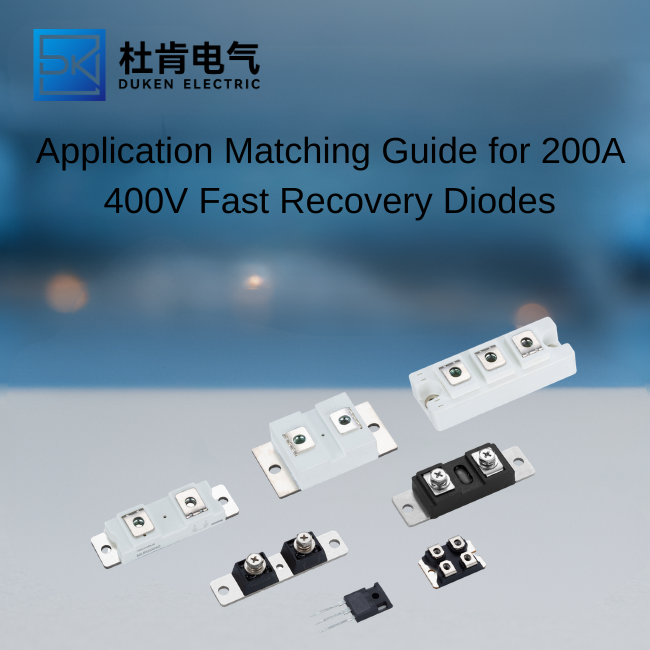
Application Matching Guide for 200A 400V Fast Recovery Diodes
Author: Selina
A 200A 400V fast recovery diode may appear suitable for many industrial power-conversion systems, but the correct model for a solar inverter is not always the best choice for a welding machine or motor drive. Each application creates a different combination of switching frequency, surge current, thermal cycling, voltage overshoot, package constraints, and maintenance requirements. Buyers should therefore select the diode according to the real operating profile rather than a generic current and voltage label.
Start With the Electrical Duty Cycle
The application determines how the diode conducts and recovers. In a line-frequency rectifier, conduction loss and surge capability may dominate. In a switching inverter, reverse recovery charge, peak recovery current, and recovery softness can strongly affect efficiency and electromagnetic interference.
Important design inputs include:
DC bus and peak reverse voltage
Average and RMS forward current
Pulse current and duration
Switching frequency
di/dt during commutation
Maximum case and junction temperature
Cooling method
Expected service life
A 200A 400V fast recovery diode should be reviewed under worst-case voltage, current, and temperature. Datasheet values measured at room temperature may not represent performance inside a hot industrial cabinet.
Solar Inverter Selection Priorities
Solar inverters operate for long periods and must maintain efficiency across changing load and temperature. Reverse recovery loss can raise switch turn-on loss and increase heat in the power stage.
For inverter applications, compare reverse recovery charge, peak recovery current, forward voltage, leakage, recovery softness, and thermal resistance. A device with a slightly higher forward voltage may still deliver better total efficiency if its recovery charge is significantly lower.
Package Choice for Solar Inverters
A for solar inverter stud mount DO-9 used in welding machine 200A 400V fast recovery diode may fit large central inverter platforms that use serviceable busbar assemblies and substantial heat sinks. The stud package can provide a robust thermal path, but it may require insulation hardware and careful torque control.
SOT-227 may be more convenient in compact or modular inverter designs. Screw terminals and a standardized footprint can reduce assembly variation, while an isolated baseplate may simplify the cooling layout if the exact model provides isolation.
Because solar equipment may operate outdoors or in hot enclosures, high-temperature leakage and thermal cycling should be included in qualification testing.
Welding Machine Selection Priorities
Welding machines subject power diodes to high pulse current, repeated thermal cycling, and severe electrical transients. In this application, surge capability and mechanical robustness can be more important than achieving the shortest possible recovery time.
The buyer should evaluate:
Non-repetitive surge current
Repetitive pulse capability
Forward voltage under pulse load
Heat-sink response
Terminal and stud strength
Resistance to thermal fatigue
DO-9 stud-mount construction is often practical for welding rectifiers because it integrates well with large heat sinks and busbars. However, incorrect torque, poor heat-sink flatness, or lateral terminal stress can shorten service life.
A for solar inverter stud mount DO-9 used in welding machine 200A 400V fast recovery diode should be tested using the actual welding duty cycle. A single surge rating does not define performance under repeated pulses.
Motor Drive and Bridge Rectifier Selection Priorities
Motor drives create rapid current commutation and voltage transients. The diode may function as a freewheeling path, commutation device, or part of a rectifier assembly.
A fast reverse recovery for bridge rectifier module for motor drive application 200A 400V fast recovery diode should be matched to the IGBT or MOSFET switching behavior. High reverse recovery current can increase switch turn-on loss, while abrupt recovery can create ringing and EMI.
Engineers should measure diode current and voltage at maximum motor load and temperature. The evaluation should include braking, regeneration, startup, overload, and fault-clearing conditions.
Bridge Rectifier Considerations
In a bridge configuration, current sharing and thermal symmetry are important. Devices should have closely matched forward voltage and thermal paths. Unequal cooling or connection resistance can cause one diode to carry more current than the others.
If the bridge operates mainly at line frequency, a standard rectifier may be sufficient. Fast recovery is valuable where switching or commutation speed creates measurable loss or stress.
SOT-227 and High-Temperature Applications
A SOT-227 package automotive application high temperature 150°C 200A 400V fast recovery diode may suit compact industrial or transportation power electronics, but the temperature and qualification claims must be interpreted correctly.
The 150°C value may indicate an absolute maximum junction temperature. Continuous operation should maintain margin below that limit. Reverse leakage, forward voltage, recovery charge, insulation resistance, and package stress should be checked at elevated temperature.
Automotive application also does not automatically mean automotive qualification. Buyers should request exact AEC-Q101 or other qualification records for the specific part number and production site.
Compare Silicon Fast Recovery With Other Options
Standard rectifier diodes are cost-effective and robust for low-frequency conversion but may create unacceptable recovery loss in switching circuits. Schottky diodes have minimal recovery and low forward voltage at lower voltage classes, although leakage can become significant at high temperature.
SiC diodes offer near-zero reverse recovery and support high-frequency, high-temperature operation. They can reduce switching loss in solar and motor-drive systems, but higher component cost and different EMI behavior must be considered.
IGBT modules with integrated freewheeling diodes simplify assembly and ensure a matched switch-diode pair. However, they reduce repair flexibility and may require replacing the entire module after a diode failure. Separate devices can be easier to service and optimize independently.
Model Selection and Procurement Approval
A technical cross-reference should compare voltage, current, surge rating, forward voltage, recovery characteristics, thermal resistance, package dimensions, polarity, isolation, and mounting requirements.
Before volume purchase, buyers should request:
Controlled datasheet and drawings
Maximum and typical recovery values
Forward and reverse characteristic curves
Thermal and surge data
RoHS and REACH declarations
Automotive qualification evidence where claimed
Batch traceability
Change-notification procedures
Samples should be tested in the real circuit. Laboratory tests should include forward voltage, reverse leakage, recovery behavior, full-load temperature, surge response, and thermal cycling. For bridge assemblies, current sharing should also be measured.
The lowest unit price should not be the only selection factor. Engineering changes, cooling hardware, assembly labor, energy loss, inventory, and downtime all contribute to total cost.
Conclusion
The correct 200A 400V fast recovery diode depends on application-specific electrical and thermal demands. Solar inverters prioritize efficiency and recovery loss, welding machines require pulse endurance and mechanical robustness, while motor drives need controlled commutation and low switching stress.
DO-9 and SOT-227 packages each offer advantages, but package choice must align with cooling, isolation, mounting, and maintenance needs. By combining application analysis, model cross-referencing, sample testing, and supplier qualification, industrial buyers can select a diode that delivers reliable long-term performance.
Frequently Asked Questions
Can one diode model be used in all three applications?
Possibly, but only after validation because solar, welding, and motor-drive duty cycles are very different.
What matters most in a welding machine?
Surge current, repetitive pulse capability, cooling, and mechanical mounting are usually critical.
What matters most in a solar inverter?
Recovery charge, switching loss, leakage, thermal resistance, and long-term stability are key.
Why is recovery softness important in motor drives?
Soft recovery can reduce ringing, voltage overshoot, and EMI.
When should SiC replace silicon fast recovery diodes?
When the efficiency and frequency benefits justify higher cost and any required redesign.
SEO Keywords: 200A 400V fast recovery diode, fast recovery diode application guide, solar inverter diode, welding machine diode, motor drive diode, bridge rectifier diode, DO-9 fast recovery diode, SOT-227 fast recovery diode, stud mount diode, high temperature diode, 150°C power diode, automotive diode application, reverse recovery charge, reverse recovery time, recovery softness, peak recovery current, surge current rating, repetitive pulse current, forward voltage drop, reverse leakage current, diode thermal resistance, inverter switching loss, welding rectifier diode, motor drive freewheeling diode, bridge current sharing, diode heat sink, diode mounting torque, power semiconductor selection, industrial rectifier diode, IGBT freewheeling diode, MOSFET diode comparison, SiC diode comparison, Schottky diode comparison, standard rectifier diode, diode model cross reference, diode supplier qualification, semiconductor traceability, RoHS compliant diode, REACH compliant diode, power electronics procurement.
READ MORE:
Incoming Inspection and Qualification Testing for 200A 400V Fast Recovery Diodes
Failure Analysis of 200A 400V Fast Recovery Diodes in High-Power Equipment
Reliability Engineering for 200A 400V Fast Recovery Diodes in Solar Inverters and Welding Systems
Optimizing Fast Recovery Diodes for Motor Drive and Bridge Rectifier Performance
DO-9 vs SOT-227: Choosing the Right 200A 400V Fast Recovery Diode Package
Total Cost of Ownership for 106A Thyristor Modules in Industrial UPS Heating Projects
Common Failure Analysis of 106A Thyristor Modules in UPS-Supported Industrial Heating Equipment