
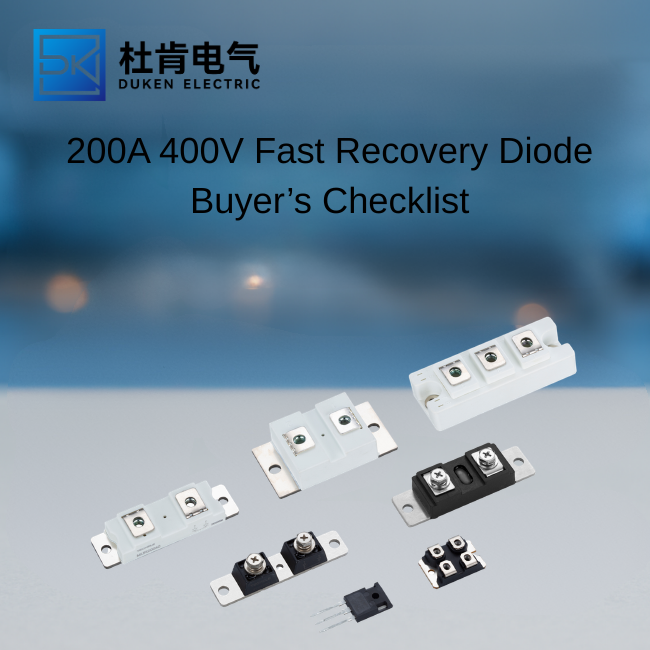
200A 400V Fast Recovery Diode Buyer’s Checklist: 5 Must-Ask Questions
Author: Selina
Selecting a 200A 400V fast recovery diode is not simply a matter of matching current and voltage ratings. In solar inverters, welding machines, motor drives, and bridge rectifier assemblies, reverse recovery behavior, thermal design, package construction, and supplier consistency can determine whether the finished equipment operates reliably or suffers from excessive switching loss, voltage overshoot, and premature failure.
Before approving a model or issuing a volume purchase order, buyers should ask five technical questions. These questions help OEM engineers, sourcing managers, and electronic component distributors compare products on measurable performance rather than headline specifications.
1. Are the 200A and 400V Ratings Valid Under Our Operating Conditions?
The first question should establish how the supplier defines the device’s current and voltage capability.
A 200A current rating may be specified at a particular case temperature, heat-sink temperature, conduction waveform, or cooling condition. It does not automatically mean the diode can carry 200A continuously inside every cabinet. Procurement teams should request the test conditions associated with average forward current, RMS current, repetitive peak reverse voltage, and non-repetitive surge current.
Important parameters include repetitive peak reverse voltage, average forward current, RMS forward current, non-repetitive surge current, forward voltage at rated current, maximum junction temperature, junction-to-case thermal resistance, and reverse leakage current at elevated temperature.
A 200A 400V fast recovery diode used on a 400V DC bus may have inadequate voltage margin because switching transients can exceed the nominal bus voltage. Engineers should measure or model overshoot caused by wiring inductance, transformer leakage, motor commutation, and switching speed before approving the voltage class.
Current margin is equally important. Welding machines produce high pulse currents, while motor drives and inverter systems may expose freewheeling diodes to repetitive switching stress. The buyer should compare the actual waveform with the conditions stated in the datasheet instead of relying on a single current number.
2. What Are the Reverse Recovery Test Conditions?
“Fast recovery” is incomplete without test conditions.
Reverse recovery time, or trr, describes how long a diode takes to stop conducting after its polarity reverses. However, trr changes with forward current, junction temperature, reverse voltage, and the rate at which forward current falls. Reverse recovery charge, peak reverse recovery current, and recovery softness may be more useful than trr alone when predicting switching loss and electromagnetic interference.
Manufacturer datasheets commonly specify recovery values under defined combinations of forward current, reverse voltage, junction temperature, and di/dt. Those conditions must be compared with the buyer’s real circuit.
For a fast reverse recovery for bridge rectifier module for motor drive application 200A 400V fast recovery diode, ask the supplier to provide maximum and typical trr, reverse recovery charge, peak reverse recovery current, recovery softness factor, test forward current, test reverse voltage, junction temperature during testing, and di/dt used in the measurement.
A diode with very short trr but abrupt recovery may generate greater voltage overshoot and EMI than a slightly slower device with soft recovery. Established ultrafast diode designs often emphasize both low recovery charge and controlled recovery behavior because these characteristics can reduce switching loss and noise.
3. Which Package Is Best for the Mechanical and Thermal Design?
Package choice affects assembly, cooling, electrical isolation, field replacement, and long-term reliability.
Stud-Mount DO-9 for Welding and High-Current Assemblies
A for solar inverter stud mount DO-9 used in welding machine 200A 400V fast recovery diode may suit rugged busbar assemblies where the stud provides both mechanical attachment and an electrical terminal. Stud packages are commonly used in industrial converters, power supplies, machine controls, and high-power drives.
Buyers should verify stud polarity, thread size and mounting torque, required heat-sink finish, insulation method, terminal stress limits, thermal compound requirements, and creepage and clearance distances.
Excessive torque can damage the package, while insufficient torque increases thermal resistance. Busbars should not pull laterally on the terminal.
SOT-227 for Compact and Electrically Isolated Designs
A SOT-227 package automotive application high temperature 150°C 200A 400V fast recovery diode may be attractive for compact equipment because the package can provide screw terminals, a defined mounting footprint, and, depending on the model, an electrically isolated base.
However, “automotive application” should not be interpreted as proof of automotive qualification. Buyers must ask whether the exact part is AEC-Q101 qualified or supported by another relevant automotive qualification record. They should also verify whether 150°C refers to maximum junction temperature, recommended operating temperature, case temperature, or a specific test condition.
For either package, the mechanical drawing and thermal data must be reviewed together. A compact module is not automatically easier to cool, and a large stud diode is not automatically more rugged under every vibration profile.
4. Does the Diode Match the Actual Application?
The same diode should not be approved for welding, solar, and motor-drive use without application-specific validation.
In a welding machine, the component may experience high pulse current, frequent thermal cycling, and severe electromagnetic transients. Surge-current capability, repetitive pulse performance, terminal integrity, and cooling response are priorities.
In a solar inverter, switching frequency, efficiency, reverse recovery loss, leakage current, and temperature stability are often more important. Fast recovery diodes are widely used in inverters and converters because their switching behavior can reduce losses compared with standard recovery devices.
In a motor drive, the diode may serve as a freewheeling or commutation device associated with an IGBT, MOSFET, or bridge rectifier stage. A fast reverse recovery for bridge rectifier module for motor drive application 200A 400V fast recovery diode should be assessed at the real switching frequency, motor current, DC-link voltage, and junction temperature.
Compared with a standard rectifier diode, a fast recovery diode generally reduces switching stress but may have a different forward-voltage trade-off. Compared with a Schottky diode, it may provide a more suitable voltage range at lower cost, while silicon-carbide diodes can offer near-zero reverse recovery at a higher purchase price. An IGBT module with an integrated antiparallel diode may simplify assembly, but it limits the buyer’s ability to optimize or replace the diode independently.
5. Can the Supplier Prove Consistency, Compliance, and Traceability?
The final question concerns the product behind the datasheet.
A capable supplier should provide a controlled datasheet with revision number, model-specific test reports, RoHS and REACH documentation, batch and date-code traceability, incoming and outgoing inspection standards, process-change notification terms, packaging and storage requirements, and warranty and failure-analysis procedures.
Sample qualification should include forward-voltage measurement, reverse leakage, recovery testing, full-load temperature measurement, surge testing, and thermal cycling. For the SOT-227 package automotive application high temperature 150°C 200A 400V fast recovery diode, high-temperature leakage and thermal-cycle stability deserve particular attention.
Buyers should also confirm whether the manufacturer reports typical or guaranteed maximum recovery values. Typical values are useful for design estimates but do not define the worst performance that production units may exhibit.
Before volume purchasing, compare samples from more than one batch. This can reveal variation in forward voltage, leakage, recovery charge, package dimensions, or terminal finish that may not be visible in a single qualification sample.
Conclusion
A reliable 200A 400V fast recovery diode must be selected through a combined electrical, thermal, mechanical, and supply-chain review. Buyers should confirm rating conditions, examine reverse recovery test data, choose a suitable package, validate the real application, and audit the supplier’s documentation and production controls.
For a for solar inverter stud mount DO-9 used in welding machine 200A 400V fast recovery diode, mounting integrity and surge performance are major concerns. For SOT-227 designs, isolation, thermal resistance, qualification status, and high-temperature behavior require careful verification. Asking these five questions before purchase helps reduce switching losses, prevent field failures, and build a more dependable power-conversion system.
Frequently Asked Questions
Is a 400V diode suitable for a 400V DC bus?
Usually not without additional analysis. Switching overshoot and transient voltage may exceed the nominal bus voltage, so engineers should select an appropriate voltage margin based on measurements and circuit protection.
Is reverse recovery time the only switching parameter that matters?
No. Reverse recovery charge, peak recovery current, softness, junction temperature, forward current, and di/dt are also important.
Which package is better: DO-9 or SOT-227?
DO-9 can be suitable for rugged stud-mounted assemblies and busbars. SOT-227 can simplify compact, screw-terminal, and potentially isolated designs. The better choice depends on cooling, isolation, mounting, vibration, and service requirements.
Can a fast recovery diode replace a standard rectifier diode?
Potentially, but the replacement must be checked for forward voltage, recovery behavior, current capacity, surge rating, thermal resistance, dimensions, and mounting requirements.
What tests should be performed before a volume order?
Recommended tests include forward-voltage measurement, reverse leakage, recovery characterization, surge-current testing, full-load thermal testing, thermal cycling, and mechanical inspection.
SEO Keywords: 200A 400V fast recovery diode, fast recovery diode buyer checklist, DO-9 fast recovery diode, SOT-227 fast recovery diode, solar inverter diode, welding machine diode, motor drive diode, bridge rectifier diode, fast reverse recovery diode, 200A diode module, 400V industrial diode, stud mount diode, automotive diode module, 150°C diode, high temperature rectifier diode, reverse recovery time, reverse recovery charge, peak reverse recovery current, recovery softness factor, surge current rating, forward voltage drop, junction temperature, thermal resistance, diode heat sink, industrial power semiconductor, rectifier diode selection, diode supplier audit, diode traceability, RoHS compliant diode, REACH compliant diode, AEC-Q101 diode, IGBT freewheeling diode, MOSFET body diode comparison, SiC diode comparison, Schottky diode comparison, industrial inverter component, welding rectifier component, motor drive semiconductor, bridge rectifier module component, power electronics procurement.
READ MORE:
Application Matching Guide for 200A 400V Fast Recovery Diodes
Incoming Inspection and Qualification Testing for 200A 400V Fast Recovery Diodes
Failure Analysis of 200A 400V Fast Recovery Diodes in High-Power Equipment
Reliability Engineering for 200A 400V Fast Recovery Diodes in Solar Inverters and Welding Systems
Optimizing Fast Recovery Diodes for Motor Drive and Bridge Rectifier Performance
DO-9 vs SOT-227: Choosing the Right 200A 400V Fast Recovery Diode Package
Total Cost of Ownership for 106A Thyristor Modules in Industrial UPS Heating Projects
Common Failure Analysis of 106A Thyristor Modules in UPS-Supported Industrial Heating Equipment