
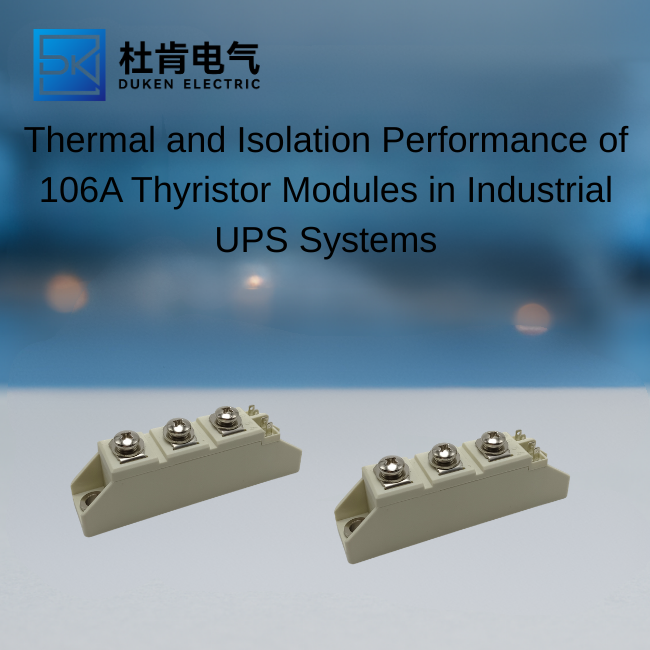
Thermal and Isolation Performance of 106A Thyristor Modules in Industrial UPS Systems
The performance parameters of suitable thyristor modules for UPS systems cannot be evaluated from current and voltage ratings alone. In a 106A power module, thermal resistance, insulation capability, forward voltage, surge tolerance, and package construction determine whether the device can operate reliably inside a UPS for thousands of hours. These factors become especially important for industrial OEMs because high cabinet temperatures, repeated load changes, bypass transfers, and limited cooling can expose an SCR module to conditions significantly more demanding than those represented by its nominal current rating.
For engineers and procurement managers, thermal design is also closely connected to lifecycle cost. A module that produces excessive heat may require a larger heat sink, higher airflow, or more frequent maintenance. Selecting the correct device therefore requires looking at the complete thermal path from the silicon junction to the UPS cabinet environment.
How Thermal Parameters Determine the Real 106A Current Capability
A thyristor's rated current is established under specified thermal and electrical conditions. It does not mean that 106A can be continuously carried regardless of heat-sink temperature, ambient temperature, waveform, or conduction angle.
During conduction, the SCR develops an on-state voltage. This voltage combined with current produces semiconductor loss. At approximately 100A, for example, an on-state voltage near 1.3V corresponds to roughly 130W of instantaneous dissipation while the device is conducting. Actual average loss depends on waveform and duty cycle, but this simple calculation demonstrates why forward characteristics become significant in a high-current UPS.
A low forward-voltage dual-SCR surge-protection 106A thyristor module for UPS systems can reduce this conduction loss, but engineers still need to analyze the thermal path. Junction-to-case thermal resistance determines how much the semiconductor junction temperature rises above the case for a given level of power dissipation. Thermal interface resistance and heat-sink-to-ambient resistance then add to the total temperature rise.
For example, two modules with identical current ratings can operate at noticeably different junction temperatures if one has lower forward loss or better thermal resistance. The cooler device may provide greater reliability margin even though the catalog headline specifications appear similar.
UPS designers should therefore examine forward-voltage curves and thermal-resistance data at realistic operating conditions. The analysis should include maximum ambient temperature rather than only the typical room-temperature case.
Cooling degradation should also be considered. Fans accumulate dust and lose performance, filters become restricted, and thermal interface materials may change over years of operation. A design that barely satisfies the junction-temperature limit when new may have inadequate margin later in its service life.
Isolation and Package Construction in UPS Power Stages
Electrical isolation is another critical parameter because power semiconductor modules are normally mounted directly to a heat sink or chassis structure. The module must transfer heat effectively without compromising electrical safety between the power circuit and mounting surface.
The required isolation level depends on UPS architecture, system voltage, applicable standards, and insulation coordination. Procurement teams should therefore avoid treating a generic statement such as "isolated package" as sufficient evidence. The specified isolation test voltage, test duration, creepage and clearance design, and exact module construction should be checked.
Mechanical mounting can also influence insulation and thermal behavior. Excessive or uneven mounting torque may stress the module base, while inadequate pressure can increase thermal interface resistance. The heat-sink surface should meet the manufacturer's flatness and finish recommendations, and the correct thermal interface material should be used.
These details become particularly important for a replacement OEM panel-mount 106A thyristor module for UPS systems. A replacement may fit within the available space but still differ in baseplate construction, insulation specification, terminal geometry, or recommended mounting method.
OEM engineers should compare the mechanical drawing of the replacement against the original assembly rather than relying on photographs or approximate dimensions. Terminal location affects busbar length and parasitic inductance, while module height can affect cabinet clearance and assembly tooling.
For high-volume manufacturing, mounting repeatability should also be considered. A package that requires unusually sensitive installation procedures may create variation between production units even if laboratory samples perform well.
Surge Performance and Thermal Cycling in Real UPS Operation
Thermal reliability is not limited to steady-state temperature. A UPS module may repeatedly move between standby, partial load, full load, and overload conditions. Each change produces expansion and contraction within the semiconductor package.
Over many cycles, these temperature variations can stress internal joints and interfaces. Package construction therefore becomes an important part of long-term reliability.
A UL file-E63532 hard-soldered-joints certified 106A thyristor module for UPS systems may be relevant when an OEM specification requires the corresponding construction and certification evidence. Buyers should verify the exact certification scope and part-number coverage with current manufacturer documentation rather than assuming that a file number applies to every similar module.
Surge events create a different form of thermal stress. During a short-duration overcurrent event, the semiconductor can heat much faster than the external heat sink can respond. The silicon and internal package structure must temporarily absorb the energy.
This is why non-repetitive surge current and I²t ratings are essential. A low forward-voltage dual-SCR surge-protection 106A thyristor module for UPS systems should have transient capability coordinated with the UPS fuse and fault-protection system.
A common engineering mistake is assuming that a high surge-current rating means the SCR can tolerate frequent overload pulses indefinitely. Non-repetitive ratings are normally specified for particular waveforms, initial temperatures, and durations. Repetitive load events require separate thermal analysis.
For UPS systems supplying motors, industrial controls, transformers, or other loads with substantial inrush, engineers should characterize the actual startup waveform. This provides a more reliable basis for SCR selection than simply applying a generic safety factor to nominal current.
Comparing SCR Modules with Alternative UPS Semiconductor Solutions
SCR modules remain useful in UPS designs because they combine high current capability, controlled turn-on, strong overload tolerance, and relatively low conduction loss. However, they should be compared with alternative devices according to the function of the power stage.
A rectifier diode is simpler when controlled turn-on is unnecessary. In an uncontrolled input rectifier, replacing a diode with an SCR would add gate-control complexity without necessarily providing a system benefit. An SCR becomes valuable where controlled rectification, soft-start functions, static switching, or managed power-path connection is required.
IGBT modules are more suitable for stages requiring rapid active switching. A UPS inverter producing an AC output through PWM typically requires controllable turn-off, which a conventional SCR cannot provide. IGBTs therefore dominate many inverter stages even when SCRs are used elsewhere in the same UPS.
MOSFETs can provide lower switching losses in suitable voltage ranges, while SiC MOSFETs offer higher-frequency operation and potentially higher power density. These advantages can reduce passive component size but may introduce higher component cost and more demanding gate-drive, layout, and EMI requirements.
The important selection principle is to avoid comparing technologies solely on one specification. A faster semiconductor is not automatically better for a line-frequency bypass switch, just as a rugged SCR is not automatically appropriate for a high-frequency inverter bridge.
Qualification Strategy for OEM Buyers and UPS Manufacturers
The performance parameters of suitable thyristor modules for UPS systems should ultimately be verified at the equipment level. Datasheet analysis narrows the candidate list, but qualification testing confirms whether a device performs correctly in the actual thermal and electrical environment.
For a 106A module, engineers should establish worst-case load current, conduction angle, blocking voltage, transient voltage, surge current, ambient temperature, and cooling capability. The candidate device should then be evaluated with realistic design margin.
For a replacement OEM panel-mount 106A thyristor module for UPS systems, prototype evaluation should include mechanical installation as well as electrical testing. Case temperature should be measured at sustained load, while startup, bypass transfer, overload, and fault-response waveforms should be reviewed for abnormal current or voltage stress.
Buyers should also examine manufacturing consistency. For volume procurement, leakage current, forward voltage, gate trigger characteristics, isolation, and dimensional tolerances should remain controlled from lot to lot. Traceability and formal change notification are valuable when the module will remain in production for several years.
Price should be evaluated only after these technical requirements are satisfied. A cheaper SCR that forces a larger heat sink, creates additional qualification work, or produces a higher field-failure rate can easily become the more expensive option over the UPS lifecycle.
Conclusion
Thermal and insulation characteristics are central to the performance parameters of suitable thyristor modules for UPS systems. A 106A rating establishes only part of the operating capability. Forward conduction loss, junction-to-case thermal resistance, heat-sink conditions, surge energy, insulation performance, and package construction determine whether that current rating can be used reliably in real equipment.
For industrial OEMs, the strongest qualification approach combines datasheet analysis with thermal calculations, mechanical verification, protection coordination, and testing inside the actual UPS platform. By evaluating these factors together, manufacturers can select thyristor modules that provide dependable electrical performance without sacrificing thermal margin, safety, or long-term service reliability.
Frequently Asked Questions
1. Why can two 106A thyristor modules run at different temperatures?
They may have different forward-voltage characteristics, thermal resistance, internal construction, and mounting requirements. The nominal current rating alone does not determine junction temperature.
2. How important is isolation voltage in a UPS SCR module?
It is important because the semiconductor module often shares a heat sink or chassis with other components. Isolation must satisfy the equipment's electrical architecture and applicable insulation requirements.
3. Can a lower forward-voltage SCR reduce heat-sink requirements?
Potentially, yes. Lower conduction loss reduces generated heat, but the complete thermal path and worst-case operating conditions still need to be calculated.
4. Should a 106A SCR be replaced by an IGBT for better efficiency?
Not automatically. IGBTs are useful for actively switched inverter stages, while SCRs can be more appropriate for controlled rectification, bypass switching, and low-frequency high-current functions.
5. What should OEM buyers verify before approving a replacement module?
They should verify electrical ratings, thermal resistance, surge and I²t capability, gate characteristics, insulation, dimensions, terminal configuration, mounting requirements, certification evidence, and production consistency.
Meta Title: Thermal Performance of 106A UPS Thyristor Modules
Meta Description: Explore thermal resistance, isolation, surge capability and package reliability when selecting 106A thyristor modules for industrial UPS systems and OEM use.
Focus Keyword: performance parameters of suitable thyristor modules for UPS systems
READ MORE:
How 106A Thyristor Modules Support Industrial UPS Power Transfer and High-Current Load Control
106A Thyristor Module Applications in UPS Rectifiers, Battery Charging, and Industrial Power Control
Why 106A Thyristor Modules Are Used in UPS Static Bypass and Surge Protection Circuits
Applications and Use Cases of 106A Thyristor Modules in Industrial UPS and Power Control Systems
How to Evaluate 106A Thyristor Module Reliability for UPS Static Bypass and Power Control
How Surge Current and Forward Voltage Define 106A Thyristor Module Performance in UPS Systems
Performance Parameters of 106A Thyristor Modules for Reliable UPS Systems