
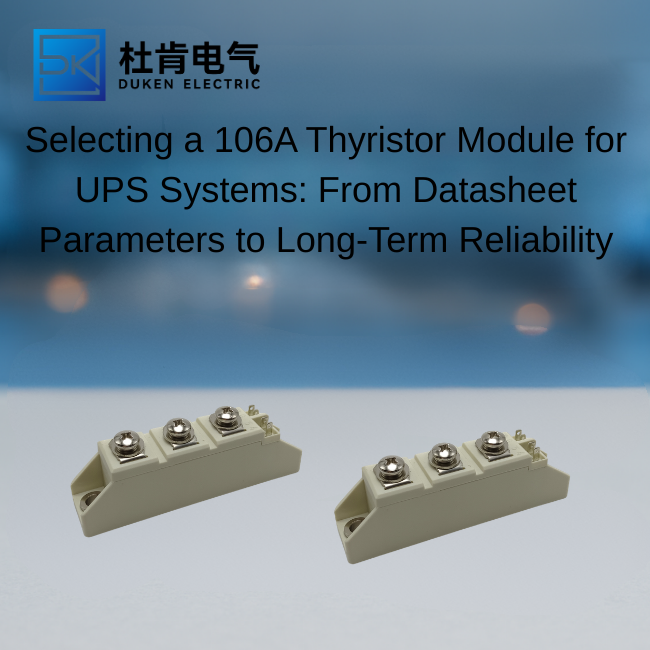
Selecting a 106A Thyristor Module for UPS Systems: From Datasheet Parameters to Long-Term Reliability
The performance parameters of suitable thyristor modules for UPS systems must be interpreted in the context of real operating conditions rather than treated as isolated datasheet numbers. For a 106A SCR module, current rating is only the starting point. Forward voltage, blocking capability, surge current, I²t, gate triggering, thermal resistance, insulation, and package construction determine whether the component can deliver reliable service inside an industrial UPS. For OEM engineers and procurement managers, understanding how these parameters interact is essential when qualifying a new design, approving an alternative supplier, or replacing an obsolete power module.
UPS equipment presents an unusual reliability challenge because the power semiconductor must perform correctly during both routine operation and exceptional events. A module may operate for months under moderate loading and then suddenly face a transfer event, inrush current, overload, or downstream fault. Selection therefore needs to address efficiency during normal operation and electrical robustness during abnormal conditions.
Translating Datasheet Ratings into Real UPS Operating Performance
A 106A current specification does not mean that the thyristor can continuously conduct 106A under any thermal condition. Datasheet current ratings are associated with defined case temperatures, conduction angles, waveforms, and cooling assumptions. The first engineering task is therefore to determine the actual current profile of the UPS.
A static bypass SCR, for example, may normally remain off and conduct heavily only during transfer. A thyristor in a controlled rectifier can experience a very different duty cycle. These two applications may use devices with similar nominal ratings, but their thermal and transient requirements are not identical.
Forward voltage deserves particular attention. A low forward-voltage dual-SCR surge-protection 106A thyristor module for UPS systems can reduce semiconductor dissipation during extended conduction. At 100A, an on-state voltage of 1.3V corresponds to approximately 130W of instantaneous conduction loss. If another candidate reaches 1.5V under comparable conditions, the instantaneous loss rises to about 150W. In continuous industrial equipment, that difference can affect heat-sink temperature, fan loading, and thermal margin.
Engineers should use the manufacturer's forward-voltage curves rather than relying solely on a typical headline value. The relevant point is the voltage drop at the expected current and junction temperature.
Blocking voltage also requires margin. Repetitive peak off-state and reverse voltage ratings should comfortably exceed normal circuit stress while accounting for line disturbances and switching transients. A higher voltage rating is not a substitute for proper snubber and surge-protection design, but inadequate blocking margin can expose the SCR to repetitive electrical stress.
Gate parameters complete the basic electrical picture. Maximum gate trigger current and voltage are more useful for worst-case driver design than typical figures. Holding and latching current should also be checked against the load waveform to ensure predictable turn-on and conduction behavior.
Surge Current and I²t Reveal More Than Nominal Current Ratings
UPS reliability is often tested during transient events rather than steady operation. Capacitor charging, transformer magnetizing current, load transfer, and downstream faults can produce currents several times higher than the normal operating value.
This is where surge-current and I²t ratings become critical.
The non-repetitive surge-current specification describes the short-duration peak current the device can survive under defined test conditions. Engineers need to examine the specified waveform, duration, initial junction temperature, and repetition assumptions. A high surge rating should never be interpreted as permission to operate the module repeatedly at that current.
I²t is particularly valuable for protection coordination. It represents the energy-related stress created by a high-current event and allows engineers to compare the SCR's withstand capability with the clearing characteristics of semiconductor fuses.
For a low forward-voltage dual-SCR surge-protection 106A thyristor module for UPS systems, strong surge capability can provide valuable protection margin, but the module still needs coordinated external protection. The fuse or protection system should interrupt an abnormal event before the thyristor exceeds its permissible thermal energy.
This becomes especially important in UPS systems supplying industrial motors, transformers, production equipment, or other loads with substantial inrush. Instead of estimating surge requirements solely from nominal load power, engineers should measure or model the actual transient current waveform.
Repeated overload conditions need separate evaluation using transient thermal impedance and realistic cooling intervals. A device that survives a single large pulse may not tolerate the same event every few seconds.
Thermal Design, Panel Mounting, and OEM Replacement Decisions
Thermal performance often determines whether a theoretically suitable SCR works reliably in production equipment. Junction-to-case thermal resistance defines part of the heat path, but it is only one element of the complete thermal system.
The practical path includes the semiconductor junction, module package, thermal interface material, heat sink, airflow, and surrounding ambient environment. Every interface adds thermal resistance.
For a replacement OEM panel-mount 106A thyristor module for UPS systems, comparing only current and voltage ratings can therefore be misleading. Suppose a candidate device fits the same electrical function but has higher thermal resistance. Installed on the original heat sink, its junction may operate at a substantially higher temperature even though the measured load current is unchanged.
Mechanical dimensions deserve the same level of scrutiny. Mounting-hole spacing, terminal location, package height, polarity, baseplate geometry, and recommended mounting torque should be compared with the original device.
High-current terminal layout is not simply a mechanical convenience. Changing busbar length or conductor geometry can alter connection resistance and parasitic inductance. In a compact UPS, even a small dimensional change can interfere with neighboring components or airflow.
A replacement OEM panel-mount 106A thyristor module for UPS systems should consequently be installed in the real assembly during qualification. Engineers should perform sustained full-load testing at elevated ambient temperature and monitor case temperature, current waveform, and voltage stress.
This application-level validation provides much stronger evidence than assuming compatibility from a catalog cross-reference.
Construction Quality and How SCRs Compare with Other Power Devices
Long-term UPS reliability also depends on internal construction. Every load cycle produces some degree of heating and cooling, creating mechanical stress through material expansion and contraction.
A UL file-E63532 hard-soldered-joints certified 106A thyristor module for UPS systems may be relevant when a project specification requires the stated construction and certification characteristics. The certification scope should always be confirmed using current documentation for the exact manufacturer and device being purchased. Procurement teams should not assume that a file reference automatically covers every module with a similar package.
Construction quality becomes particularly important when comparing suppliers for long-term OEM production. Stable semiconductor characteristics, controlled internal joining processes, consistent insulation, and traceability can reduce variation between production lots.
The SCR should also be compared with alternative semiconductor technologies according to circuit function. A rectifier diode is simpler and appropriate where uncontrolled conduction is acceptable, but it cannot provide gate-controlled turn-on.
An IGBT provides active turn-on and turn-off, making it more suitable for PWM inverter stages. MOSFETs are effective in high-frequency switching applications within appropriate voltage and current ranges, while SiC MOSFETs and SiC diodes can reduce switching losses and enable higher switching frequencies.
Those advantages do not make newer devices automatically superior in every UPS power stage. For line-frequency controlled rectification, static switching, or high-current bypass functions, an SCR can offer low conduction loss, straightforward control, and strong surge capability at an attractive system cost.
The correct comparison therefore considers switching frequency, conduction time, overload behavior, gate-drive requirements, cooling, protection, and total system economics.
Building a Reliable Procurement Specification for a 106A UPS Module
For industrial sourcing, the performance parameters of suitable thyristor modules for UPS systems should be converted into a technical purchasing specification. This prevents procurement decisions from becoming simple comparisons of 106A labels and unit prices.
The specification should establish minimum blocking voltage, operating current conditions, maximum acceptable forward characteristics, required surge and I²t capability, gate-drive compatibility, thermal resistance, junction-temperature limit, and insulation requirements.
Mechanical requirements should reference controlled drawings. For a panel-mounted replacement, terminal positions, hole spacing, package dimensions, mounting interface, and polarity should have defined tolerances.
Supplier qualification should also examine production consistency. OEM buyers may receive excellent engineering samples but later encounter variation when volume manufacturing begins. Lot traceability, change-notification procedures, controlled datasheet revisions, and quality documentation help reduce this risk.
Incoming verification can focus on parameters that are practical to monitor, such as forward voltage, blocking leakage, gate trigger characteristics, isolation where appropriate, and critical dimensions.
The final purchasing decision should consider total lifecycle value. A module with a slightly lower unit price can become expensive if it increases heat-sink requirements, forces mechanical redesign, produces inconsistent triggering, or creates additional field-service risk.
For UPS equipment expected to remain in service for many years, predictable availability and manufacturing consistency are also part of component performance.
Conclusion
The performance parameters of suitable thyristor modules for UPS systems extend far beyond a nominal 106A current rating. Forward voltage determines conduction loss, surge current and I²t indicate transient robustness, gate characteristics influence reliable triggering, and thermal resistance determines how effectively semiconductor losses can be removed from the junction.
For OEM replacement and new UPS development, these electrical parameters must be combined with insulation, mechanical compatibility, package construction, supplier traceability, and realistic application testing. Comparing SCRs with IGBTs, rectifier diodes, MOSFETs, and SiC devices should also be based on the actual function of the power stage rather than on a single technology advantage.
A carefully qualified 106A thyristor module gives UPS manufacturers more than adequate electrical ratings. It provides predictable thermal behavior, reliable fault tolerance, easier production integration, and a stronger foundation for long-term equipment reliability.
Frequently Asked Questions
1. Which parameters should be checked first when selecting a 106A UPS thyristor?
Start with blocking voltage, real operating current, forward voltage, surge current, I²t, gate requirements, thermal resistance, and maximum junction temperature.
2. Why can two 106A modules perform differently in the same UPS?
They may have different conduction losses, thermal resistance, surge capability, gate characteristics, internal construction, and package interfaces despite sharing the same nominal current rating.
3. How should an OEM verify a replacement panel-mount thyristor?
Compare electrical and mechanical specifications, install samples in the actual heat-sink assembly, and test full load, elevated temperature, transfer, overload, and relevant transient conditions.
4. Is a thyristor still suitable when SiC devices are available?
Yes. SCRs remain attractive for many controlled rectification, static bypass, and low-frequency high-current applications where rugged surge performance and low conduction losses are priorities.
5. Should the cheapest compliant 106A module be selected?
Not necessarily. Thermal performance, reliability, production consistency, documentation, mechanical compatibility, supply continuity, and qualification costs can have a greater impact on total lifecycle cost than unit price alone.
Meta Title: How to Select 106A Thyristor Modules for UPS Systems
Meta Description: Learn how to evaluate 106A UPS thyristor modules by forward voltage, surge I²t, thermal performance, OEM compatibility and long-term reliability factors.
Focus Keyword: performance parameters of suitable thyristor modules for UPS systems
READ MORE:
How 106A Thyristor Modules Support Industrial UPS Power Transfer and High-Current Load Control
106A Thyristor Module Applications in UPS Rectifiers, Battery Charging, and Industrial Power Control
Why 106A Thyristor Modules Are Used in UPS Static Bypass and Surge Protection Circuits
Applications and Use Cases of 106A Thyristor Modules in Industrial UPS and Power Control Systems
How to Evaluate 106A Thyristor Module Reliability for UPS Static Bypass and Power Control
Thermal and Isolation Performance of 106A Thyristor Modules in Industrial UPS Systems
How Surge Current and Forward Voltage Define 106A Thyristor Module Performance in UPS Systems
Performance Parameters of 106A Thyristor Modules for Reliable UPS Systems