
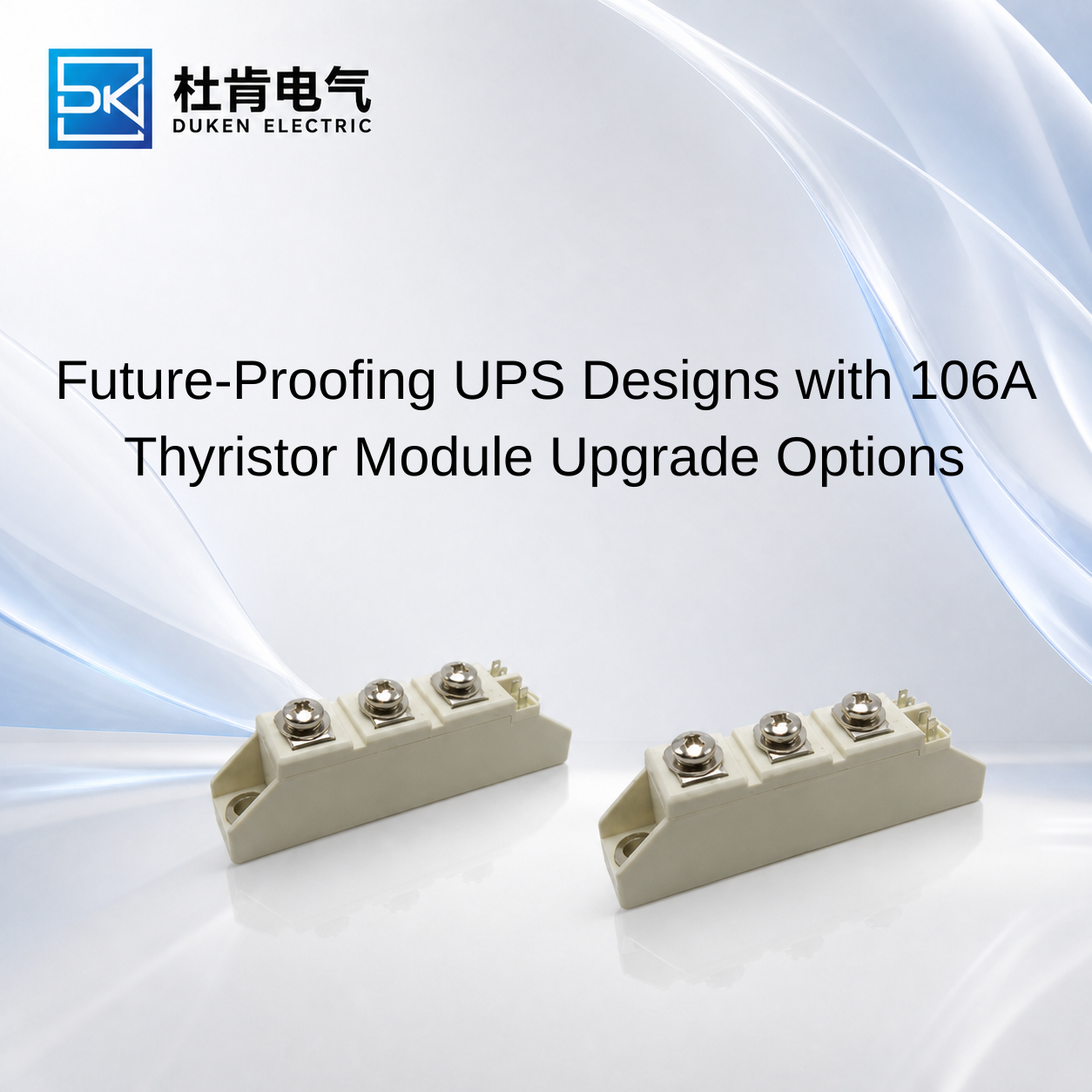
Future-Proofing UPS Designs with 106A Thyristor Module Upgrade Options
For UPS manufacturers, component distributors, and maintenance teams, Related Products and Upgrades of thyristor modules is increasingly about maintaining design flexibility rather than simply replacing a failed semiconductor. A 106A SCR module may remain electrically suitable for many years, while sourcing conditions, cooling requirements, compliance expectations, or equipment power density change around it. A well-planned upgrade strategy therefore considers compatible SCR alternatives, higher dv/dt devices, different thermal constructions, and related semiconductor technologies. The objective is to improve availability and reliability without introducing unnecessary changes to a proven UPS power stage.
Building a Practical Upgrade Roadmap for a 106A UPS Platform
A useful upgrade roadmap starts with the electrical function of the original thyristor module.
SCRs remain well suited to line-frequency applications because they combine controlled turn-on with high-current capability and natural commutation in suitable AC circuits. Depending on UPS architecture, thyristor modules can be used in controlled input stages, static bypass functions, battery charging circuits, or other power-control sections.
When engineers investigate Related Products and Upgrades of thyristor modules, the first question should therefore be whether the existing circuit function will remain unchanged.
If it will, a compatible SCR replacement is usually the most straightforward path. The candidate device should have the required internal topology and appropriate current and blocking-voltage ratings, while remaining compatible with the existing gate driver, cooling assembly, terminals, and mounting structure.
The 106A current designation alone is insufficient for this decision. IT(AV) or the applicable current rating is defined under specific datasheet conditions involving waveform, conduction angle, case temperature, and cooling.
On-state voltage is another important parameter because it influences normal conduction loss:
Pcond ≈ VT × IT(avg)
Thermal resistance should then be considered together with VT. A module with an apparently generous current rating can still create thermal problems if its losses and cooling requirements are poorly matched to the existing assembly.
Engineers should additionally compare VDRM/VRRM, ITSM, I²t, IGT/VGT, dv/dt and di/dt. For replacement sourcing, these electrical parameters should be evaluated alongside package dimensions, internal circuit configuration, terminal functions, and thermal-interface requirements.
This creates a technical baseline against which future module alternatives can be qualified.
Improving AC Power Control with Anti-Parallel and High-dv/dt Designs
A panel-mount anti-parallel forced-air-cooling 106A thyristor module for ups systems can be a useful related product when the UPS circuit requires controlled conduction in both directions of an AC waveform.
The anti-parallel arrangement consists of thyristor paths oriented in opposite directions. This differs fundamentally from series, common-anode, or common-cathode dual-SCR configurations.
Consequently, anti-parallel construction should never be treated as a generic replacement feature. Engineers must first confirm that the UPS circuit requires this topology.
The forced-air-cooling aspect also affects upgrade planning. Heat produced during conduction must travel from the semiconductor junction through the package, thermal interface, heat sink, and finally into the cooling air.
A panel-mount anti-parallel forced-air-cooling 106A thyristor module for ups systems may integrate effectively into conventional UPS cabinets because forced-air heat sinks are relatively straightforward to service. However, fan condition, dust, blocked filters, and elevated inlet temperature can reduce cooling effectiveness over the equipment lifetime.
Electrical transient performance provides another possible upgrade direction.
A high-dv/dt 7-pin industrial-grade 106A thyristor module for ups systems may offer additional tolerance to rapid changes in voltage while the SCR is blocking. This can be useful where switching events or other circuit conditions create demanding voltage transitions.
The relationship between capacitance and voltage change can be represented simply as:
i = C × dv/dt
Higher device capability can increase design margin, but it should not be used as a substitute for good circuit engineering. Snubbers where appropriate, gate-circuit design, transient suppression, transformer behavior, and wiring layout still require consideration.
A high-dv/dt 7-pin industrial-grade 106A thyristor module for ups systems must also match the existing gate driver. IGT and VGT should be verified, and the seven terminals must be checked individually against the original circuit diagram. An identical terminal count does not establish pin-to-pin equivalence.
Using Thermal Architecture as an Upgrade Decision
Some UPS redesigns are driven less by electrical performance than by power density.
When cabinet dimensions become smaller or internal power increases, the existing cooling arrangement may approach its thermal limits. This can encourage engineers to investigate alternative module constructions and cooling technologies.
An aluminum-oxide baseplate water-cooling RoHS-compliant 106A thyristor module for ups systems represents one possible direction for equipment designed around a liquid-cooled thermal architecture.
Aluminum oxide is used as an insulating ceramic in power semiconductor construction. It can contribute to electrical isolation while allowing heat to move toward the module's cooling surface. However, engineers should always use the module's actual thermal-resistance specifications for calculations rather than assuming performance from the ceramic material alone.
The junction-to-case relationship can initially be considered through:
Tj = Tc + P × Rth(j-c)
The complete thermal path extends further through the interface and cooling structure.
For an aluminum-oxide baseplate water-cooling RoHS-compliant 106A thyristor module for ups systems, the cold plate and liquid loop become important parts of that path. Coolant inlet temperature, flow stability, cold-plate contact, pump reliability, sealing, and maintenance all influence practical performance.
Liquid cooling can therefore be attractive in high-power-density designs, but it introduces system complexity that does not exist to the same degree in conventional forced-air arrangements.
For an existing UPS that already operates reliably with air cooling, changing to water cooling solely to accommodate a different module is unlikely to be the simplest upgrade. For a new platform where thermal architecture can be designed from the beginning, liquid cooling may deserve more consideration.
RoHS requirements should likewise be treated as a procurement specification. When compliance is required, buyers should obtain suitable supplier documentation rather than relying solely on a product description.
Comparing Related SCR, Diode and IGBT Products
Future-proofing also requires understanding which related semiconductor products are genuine alternatives and which require circuit redesign.
A higher-current SCR module may be the first option considered when additional operating margin is desired. Moving above the 106A class can potentially provide more current capability, but the practical benefit should be confirmed through VT, Rth(j-c), rating conditions, surge capability, and application testing.
Mechanical changes can also appear. Larger modules may use different footprints, terminal spacing, busbar arrangements, or heat-sink contact areas.
A rectifier diode is another related power semiconductor, but it performs uncontrolled rectification. If the UPS circuit requires controlled turn-on, replacing the SCR with a diode removes that control function. A diode is therefore only an alternative when the topology itself permits uncontrolled conduction.
IGBT modules offer active gate-controlled turn-on and turn-off and are appropriate for high-frequency PWM conversion. This makes them important in UPS inverter stages, but it does not make them universal SCR replacements.
High-frequency switching introduces switching loss:
Psw ≈ Esw × fs
It also changes requirements for gate driving, protection, filtering, electromagnetic compatibility, and control strategy.
For a proven line-frequency thyristor circuit, retaining SCR technology may therefore provide the lowest-risk upgrade. For a new UPS generation requiring higher-frequency control, an IGBT-based architecture can be evaluated as part of a complete redesign.
Procurement Strategy for Long-Term UPS Production
A future-proof component strategy should reduce dependence on a single model without compromising technical consistency.
The first practical step is to create an approved specification based on the application rather than one manufacturer's part number. This specification can define required topology, current and voltage characteristics, gate requirements, thermal performance, surge capability, dimensions, and cooling interface.
Candidate alternatives can then be evaluated against the same requirements.
Sample testing should include representative operating conditions rather than only confirming that the UPS powers on. Temperature behavior, gate triggering, blocking performance, and operation under expected load conditions should be evaluated according to the manufacturer's qualification plan.
For production sourcing, consistency across batches becomes equally important. Traceability and stable manufacturing specifications can help OEMs investigate field issues and manage future deliveries.
Long-term availability should also be considered before an existing module reaches end-of-life. Qualifying an alternative while the original product is still available gives engineering teams more time for proper testing and reduces pressure to approve an emergency substitute.
This proactive approach transforms Related Products and Upgrades of thyristor modules from a reactive purchasing task into a component-lifecycle strategy.
Conclusion
Future-proofing a 106A thyristor-based UPS platform does not necessarily mean replacing SCR technology. In many line-frequency power-control functions, thyristors continue to provide a practical combination of controlled conduction, high-current capability, and straightforward system integration.
Upgrade opportunities can instead focus on improved dv/dt margin, alternative module configurations, stronger thermal design, more appropriate cooling, or qualified second-source availability.
A successful decision should consider current and blocking voltage together with VT, Rth(j-c), IGT/VGT, ITSM, I²t, dv/dt, di/dt, topology, terminal arrangement, package dimensions, and cooling requirements.
For industrial UPS manufacturers, the strongest upgrade strategy is one that improves reliability and supply flexibility while preserving proven parts of the system wherever possible. By qualifying alternatives before they become urgently necessary, manufacturers can reduce component-obsolescence risk and create a more sustainable sourcing strategy for long-life UPS equipment.
FAQ
Q1: What is the best upgrade for an existing 106A thyristor module?
There is no universal answer. A compatible SCR with appropriate topology, voltage, current, gate, thermal, surge, and mechanical characteristics is often the lowest-risk option.
Q2: When is a high-dv/dt SCR worth considering?
It can be useful when the circuit experiences demanding voltage transitions, although snubber design, gate circuitry, layout, and transient suppression should still be evaluated.
Q3: Can water cooling improve UPS power density?
Potentially. Liquid cooling can provide effective heat removal, but it also introduces cold-plate, pump, coolant, sealing, and maintenance requirements.
Q4: Is a higher-current SCR automatically a better upgrade?
No. VT, thermal resistance, gate characteristics, package dimensions, rating conditions, and actual application performance should also be compared.
Q5: Why qualify a second-source thyristor before the original becomes obsolete?
Early qualification allows sufficient time for technical testing and supplier evaluation, reducing the risk of approving an unsuitable replacement during a supply emergency.
READ MORE:
How to Qualify a 106A Thyristor Module Upgrade for Long-Term UPS Reliability
Forced-Air vs Water-Cooled 106A Thyristor Modules: Choosing the Right UPS Upgrade
High-dv/dt 106A Thyristor Modules for UPS Systems: When Is an Upgrade Worthwhile?
Upgrade Paths for 106A Thyristor Modules in UPS Power Systems
Procurement and Reliability Criteria for 300A Phase Control Thyristors in Industrial Equipment
Application Engineering for 300A Phase Control Thyristors in AC and DC Industrial Power Systems
Surge Current and Protection Design for 300A Phase Control Thyristors in Industrial Rectifiers
Thermal Design for 300A Phase Control Thyristors in Continuous Industrial Operation
300A Phase Control Thyristor for Industrial Use: Performance, Selection and Application Guide