
本文分析了200A 400V快速恢复二极管在工业应用中的故障机理、常见失效原因及预防措施。核心要点如下:
**主要故障原因:**
- 热过应力:散热不足导致结温超限,引起半导体退化、漏电流增加和内部损伤
- 反向恢复失效:存储电荷产生恢复电流,导致电压尖峰、振荡和开关损耗
- 浪涌电流损坏:电机启动、变压器励磁等瞬态过载造成结损伤
- 过电压击穿:开关瞬变和电网扰动超过阻断能力
- 漏电流随老化增加:高温和电应力加速半导体性能退化
**预防方法:**
- 优化散热设计:合理选择散热器、确保气流和正确安装
- 匹配反向恢复特性:与IGBT/MOSFET开关特性相匹配
- 选择足够浪涌裕量:设置保护电路和限流设计
- 提供电压裕量:采用缓冲电路和浪涌保护器件
- 评估供应商质量:核查数据手册准确性和可靠性测试数据
**技术比较:**
- 相比标准整流二极管,快速恢复二极管具有更快开关速度和更低损耗
- 在200A工业应用中,硅基快速恢复二极管在成本效益和成熟度上仍具优势,SiC二极管虽性能更好但成本较高
**采购建议:**
- 综合评估电流、电压、恢复特性、浪涌能力和热规格,而非仅看额定电流
- 关注供应商的可靠性测试和长期供货能力
工业设备制造商通过深入理解这些失效机制,可有效提高设备可靠性、降低维护成本。
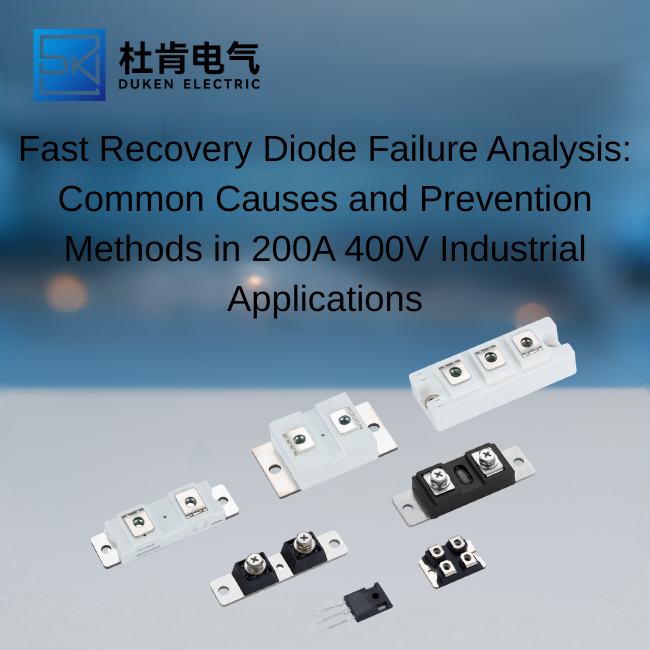
Fast Recovery Diode Failure Analysis: Common Causes and Prevention Methods in 200A 400V Industrial Applications
Introduction
A fast recovery diode failure analysis for 200A 400V industrial applications helps engineers identify the main causes of semiconductor damage and improve system reliability. High-current diode failures can lead to unexpected equipment downtime, production losses, and increased maintenance costs in industrial systems such as inverter drives, welding machines, rectifiers, battery chargers, and power conversion equipment.
A 200A 400V fast recovery diode is designed to handle high electrical stress, fast switching cycles, and continuous operation. However, incorrect component selection, insufficient thermal management, excessive surge current, or improper installation can significantly reduce its service life.
For industrial equipment manufacturers and purchasing engineers, understanding failure mechanisms is essential when selecting reliable semiconductor components. This article analyzes common failure causes, prevention methods, technical evaluation criteria, and how to improve the long-term performance of fast recovery diode systems.
Understanding Fast Recovery Diode Failure Mechanisms
Fast recovery diodes operate under repeated electrical and thermal stress. Unlike simple low-power semiconductor devices, industrial high-current diodes must continuously manage large current flow and switching transitions.
Common failure mechanisms include:
Thermal overload
Reverse recovery stress
Excessive surge current
Overvoltage breakdown
Increased leakage current
Mechanical and installation failures
A detailed failure analysis helps engineers identify whether the problem comes from:
Device selection
Circuit design
Cooling system
Operating environment
Manufacturing quality
Common Causes of 200A 400V Fast Recovery Diode Failure
Thermal Overstress and Junction Temperature Problems
Thermal failure is one of the most common causes of power semiconductor damage.
During operation, heat is generated by:
Forward conduction loss
Reverse recovery loss
Leakage current
Switching stress
If heat cannot be removed effectively, junction temperature may exceed the safe operating range.
High temperature can cause:
Semiconductor degradation
Increased leakage current
Reduced switching performance
Internal bonding damage
Common thermal problems include:
Undersized heat sinks
Poor thermal interface materials
Insufficient airflow
Incorrect mounting pressure
Prevention Methods
To prevent thermal failure, engineers should evaluate:
Thermal resistance
Heat sink capability
Cooling method
Ambient temperature
Continuous load conditions
A proper thermal design can significantly extend diode lifetime.
Reverse Recovery Failure
Reverse recovery performance is critical for fast switching applications.
When a diode changes from conducting mode to blocking mode, stored charge creates reverse recovery current.
If the recovery process creates excessive stress, it may result in:
Voltage spikes
Oscillation
Electromagnetic interference
Additional switching losses
In inverter systems, poor matching between the diode and switching device can increase failure risk.
Prevention Methods
Engineers should evaluate:
Reverse recovery time (trr)
Recovery softness
Reverse recovery charge
Switching frequency compatibility
A suitable fast recovery diode should match the operating characteristics of the IGBT or MOSFET switching circuit.
Surge Current and Overload Damage Analysis
Industrial equipment frequently experiences temporary current peaks.
Common causes include:
Motor startup
Transformer energizing
Load switching
Short circuit conditions
A diode with insufficient surge current capability may suffer from:
Junction damage
Internal cracking
Permanent performance degradation
For a 200A 400V fast recovery diode, surge capability is an important parameter because industrial loads rarely operate under perfectly stable conditions.
Prevention Methods
Engineers should consider:
Surge current rating
Protection circuits
Current limiting design
Proper device selection
Using a diode with sufficient safety margin reduces unexpected failures.
Overvoltage and Electrical Stress Failures
Voltage spikes are another major cause of semiconductor failure.
Possible sources include:
Switching transients
Poor circuit layout
Insufficient protection components
Grid disturbances
Excessive reverse voltage may exceed the diode blocking capability and cause permanent breakdown.
Prevention Methods
Recommended solutions include:
Proper voltage margin selection
Snubber circuits
Surge protection devices
Optimized PCB and busbar design
Selecting a 200A 400V fast recovery diode with appropriate voltage capability is essential for reliable industrial operation.
Reverse Leakage Current Increase and Long-Term Aging
Reverse leakage current normally remains very small when the diode is blocking voltage.
However, aging and electrical stress may increase leakage current.
High leakage current can cause:
Additional heat generation
Reduced efficiency
Thermal instability
Factors affecting leakage current include:
High temperature exposure
Semiconductor aging
Electrical overstress
Manufacturing defects
Prevention Methods
Buyers should evaluate:
Leakage current specifications
Temperature characteristics
Supplier quality control
Reliability testing data
Low leakage current performance contributes to long-term system stability.
Comparison With IGBT, MOSFET, SiC Diode and Standard Rectifier Technologies
Fast Recovery Diode vs IGBT Module
IGBT modules are commonly used as switching devices in industrial converters.
IGBT advantages:
High voltage capability
Controlled switching
High power handling
Fast recovery diodes support IGBT systems by providing:
Freewheeling paths
Reverse current protection
Energy circulation functions
Failure analysis should consider both devices together because they operate as a system.
Fast Recovery Diode vs MOSFET
MOSFET devices provide high switching speed and are widely used in high-frequency applications.
Advantages include:
Fast switching
Low drive power
Compact designs
However, for 200A industrial applications, fast recovery diodes often provide better:
Current capability
Thermal stability
Cost efficiency
Fast Recovery Diode vs SiC Diode
SiC diodes provide:
Lower switching losses
Higher temperature capability
Improved efficiency
However, silicon fast recovery diodes remain widely used because they provide:
Reliable industrial performance
Mature manufacturing processes
Competitive pricing
Fast Recovery Diode vs Rectifier Diode
Standard rectifier diodes are suitable for low-frequency systems.
Fast recovery diodes are preferred for applications requiring:
Faster switching
Lower losses
Higher efficiency
Better dynamic performance
Industrial Reliability Improvement Recommendations
Correct Component Selection
Before purchasing a fast recovery diode, engineers should review:
Current rating
Voltage rating
Reverse recovery characteristics
Surge capability
Thermal specifications
Selecting a diode only based on current rating may lead to reliability problems.
Improve Cooling Design
Thermal management should include:
Proper heat sink selection
Efficient airflow
Correct thermal interface materials
Appropriate installation method
Good cooling design prevents temperature-related failures.
Evaluate Supplier Quality
Industrial buyers should consider:
Datasheet accuracy
Production consistency
Reliability testing
Technical support
Long-term supply capability
Reliable semiconductor suppliers reduce production risks.
Future Trends in Fast Recovery Diode Reliability
Industrial power electronics continue moving toward:
Higher power density
Higher switching frequency
Smaller equipment size
Better energy efficiency
Future diode technologies will focus on:
Improved semiconductor materials
Better thermal structures
Advanced packaging
Higher reliability testing
Although SiC technology continues developing, reliable fast recovery diodes remain important for many industrial applications.
Conclusion
A fast recovery diode failure analysis for 200A 400V industrial applications provides valuable guidance for engineers designing reliable power systems.
By understanding thermal overload, reverse recovery stress, surge current damage, overvoltage failure, and leakage current problems, manufacturers can improve equipment reliability and reduce maintenance costs.
Proper component selection, thermal design, electrical protection, and supplier evaluation are essential for achieving long-term performance in industrial inverter systems, welding equipment, rectifiers, and power conversion applications.
FAQ
1. What is the most common cause of fast recovery diode failure?
Thermal overstress caused by insufficient cooling or excessive electrical loading is one of the most common failure causes.
2. How can reverse recovery failure be prevented?
Engineers should select suitable recovery characteristics and ensure compatibility with switching devices such as IGBT or MOSFET modules.
3. Why is surge current capability important?
It protects the diode during temporary overload conditions such as startup and sudden load changes.
4. How does high temperature affect diode reliability?
High temperature increases leakage current, accelerates aging, and reduces semiconductor lifetime.
5. What should buyers check before purchasing?
Buyers should evaluate electrical ratings, thermal performance, reliability data, package design, and supplier quality.
Meta Title
Fast Recovery Diode Failure Analysis 200A 400V Guide
Meta Description
Analyze common 200A 400V fast recovery diode failures including thermal stress, surge damage, reverse recovery issues and industrial prevention methods.
Focus Keyword
Fast recovery diode failure analysis 200A 400V industrial applications
READ MORE: