
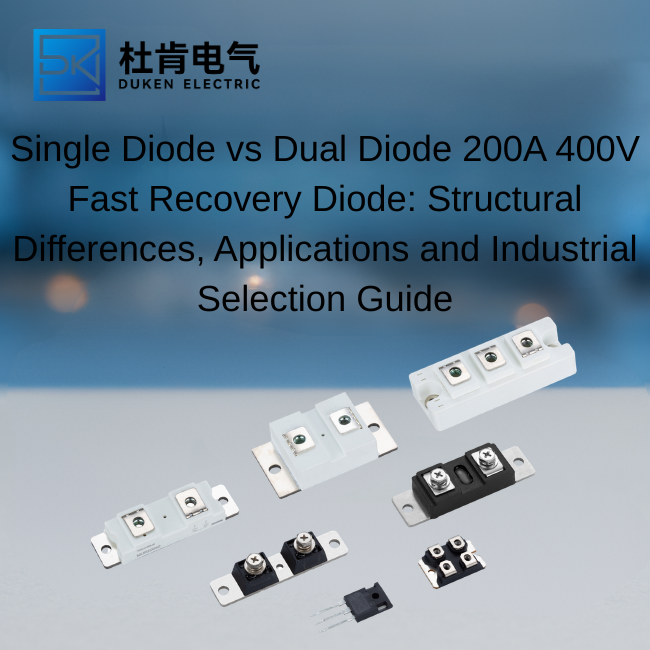
Single Diode vs Dual Diode 200A 400V Fast Recovery Diode: Structural Differences, Applications and Industrial Selection Guide
Introduction
Selecting between a single diode and dual diode 200A 400V fast recovery diode solutions is an important decision for engineers designing industrial power electronics systems. While both configurations provide fast switching performance and high current capability, their internal structures, circuit integration methods, thermal behavior, and application advantages are different.
In industrial applications such as inverter drives, welding equipment, battery chargers, and high-power converters, diode selection directly affects system efficiency, reliability, space utilization, and manufacturing cost. A single diode structure may provide design simplicity and flexibility, while a dual diode configuration can reduce component count and improve circuit integration.
Understanding Single Diode and Dual Diode Structures
Single Diode Configuration
A single fast recovery diode contains one semiconductor diode element inside the package. It provides a direct current path between the anode and cathode terminals.
Main advantages include:
Simple electrical design
Easy circuit integration
Independent current control
Flexible PCB or busbar layout
Straightforward thermal management
Single diode solutions are commonly selected when designers require independent control of each current path or when the circuit topology requires separate diode placement.
Typical applications include:
Industrial rectifiers
Power supplies
Protection circuits
Custom converter designs
Dual Diode Configuration
A dual diode integrates two diode elements inside one package.
Depending on the internal connection, dual diode structures may include:
Common cathode configuration
Common anode configuration
Series connection structure
The main advantages include:
Reduced component count
Smaller installation space
Simplified assembly
Improved circuit consistency
Dual diode solutions are widely used in inverter systems, welding machines, and compact power modules where space and reliability are important.
Key Technical Parameters for 200A 400V Fast Recovery Diode Selection
When selecting between single and dual diode solutions, engineers should evaluate electrical and thermal specifications.
Forward Current Capability
A 200A rating indicates the continuous current handling capability of the diode under specified cooling conditions.
Engineers should consider:
Continuous load current
Duty cycle
Cooling capability
Ambient temperature
A dual diode configuration may provide advantages when two current paths are required within a limited installation space.
Reverse Recovery Performance
Reverse recovery time is a critical parameter for high-frequency applications.
Important factors include:
Recovery speed
Recovery softness
Reverse recovery charge
A fast recovery diode with optimized switching characteristics helps reduce:
Switching losses
Heat generation
Electrical stress
For inverter systems using IGBT or MOSFET devices, recovery performance directly influences overall efficiency.
Forward Voltage Drop and Conduction Loss
Forward voltage drop affects energy loss during conduction.
Lower conduction loss provides:
Reduced thermal generation
Higher efficiency
Lower cooling requirements
For high-current applications, selecting a diode with suitable forward characteristics can significantly improve system performance.
Thermal Characteristics
Thermal design is critical for both single and dual diode structures.
Important parameters include:
Junction temperature
Thermal resistance
Heat sink compatibility
Package design
Dual diode packages may simplify thermal design by reducing the number of separate components, but proper heat dissipation remains essential.
Application Comparison Between Single Diode and Dual Diode Solutions
Inverter Drive Systems
Industrial inverter drives require reliable current control and efficient switching.
Dual diode solutions can provide advantages by:
Reducing installation space
Simplifying wiring
Improving system integration
Single diode solutions may be preferred when:
Custom circuit layouts are required
Independent diode control is needed
Higher design flexibility is important
Welding Equipment
Modern inverter welding machines require compact and efficient power components.
Dual diode 200A 400V fast recovery diode solutions are often selected because they provide:
Reduced component quantity
Compact design
Simplified assembly
Fast recovery characteristics help reduce switching losses during high-frequency operation.
Battery Charging Systems
Industrial battery chargers require stable rectification and reliable current handling.
Single diode solutions may provide easier maintenance and replacement, while dual diode structures can improve:
System compactness
Manufacturing efficiency
Internal circuit organization
Industrial Power Supplies
Power supply manufacturers often select diode structures according to:
Output current requirements
Space limitations
Manufacturing cost targets
Thermal design
Comparison With IGBT, MOSFET, SiC Diode and Bridge Rectifier Technologies
Fast Recovery Diode vs IGBT Module
IGBT modules are active switching devices commonly used in industrial converters.
IGBT advantages:
High voltage operation
Controlled switching
High power capability
Fast recovery diodes work together with IGBTs by providing:
Freewheeling paths
Reverse current handling
Protection functions
Fast Recovery Diode vs MOSFET
MOSFET devices provide excellent switching speed.
Advantages include:
High frequency operation
Low switching losses
Compact designs
However, for high-current industrial applications, fast recovery diodes often provide better:
Cost efficiency
Current capability
Long-term reliability
Fast Recovery Diode vs SiC Diode
SiC diodes offer:
Extremely low recovery losses
High temperature capability
Improved efficiency
However, traditional fast recovery diodes remain popular because they provide a practical balance between:
Performance
Cost
Availability
Fast Recovery Diode vs Bridge Rectifier
Bridge rectifiers integrate multiple diode elements into a complete rectification structure.
Advantages:
Simplified AC/DC conversion
Easy installation
However, individual fast recovery diode solutions may provide better flexibility for high-performance industrial designs.
Industrial Selection Guide for Buyers
When selecting a single diode or dual diode 200A 400V fast recovery diode, purchasing teams should consider several factors.
Circuit Design Requirements
Engineers should evaluate:
Electrical topology
Current path requirements
Space limitations
Maintenance considerations
Manufacturing Efficiency
Dual diode solutions may reduce:
Assembly time
Component quantity
Wiring complexity
This can benefit high-volume equipment production.
Reliability Requirements
Buyers should review:
Datasheet information
Thermal specifications
Electrical testing standards
Supplier production capability
A reliable semiconductor supplier helps ensure consistent equipment performance.
Future Trends in Fast Recovery Diode Design
Power electronics are moving toward:
Higher power density
Smaller system size
Improved efficiency
Integrated semiconductor solutions
Dual diode structures are expected to remain important in applications where compact design and simplified assembly are priorities.
At the same time, single diode solutions will continue to be valuable for customized industrial systems requiring maximum design flexibility.
Conclusion
The choice between a single diode and dual diode 200A 400V fast recovery diode depends on application requirements, circuit design, thermal conditions, and manufacturing goals.
Single diode solutions provide flexibility and independent control, while dual diode structures offer compact integration and simplified system design.
By evaluating current rating, recovery performance, conduction loss, thermal characteristics, and application requirements, engineers can select the most suitable diode solution for industrial power electronics.
FAQ
1. What is the main difference between single diode and dual diode structures?
A single diode contains one semiconductor element, while a dual diode integrates two diode elements into one package.
2. Why choose a dual diode solution?
Dual diode designs reduce component count, save installation space, and simplify circuit assembly.
3. Are dual diodes better than single diodes?
Not always. The best choice depends on circuit design, thermal requirements, and application conditions.
4. Where are 200A 400V fast recovery diodes used?
They are used in inverter drives, welding machines, battery chargers, rectifiers, and industrial power systems.
5. Should engineers consider SiC diodes instead?
SiC diodes are suitable for high-efficiency applications, while fast recovery diodes remain practical for many industrial systems.
Meta Title
Single vs Dual 200A 400V Fast Recovery Diode Guide
Meta Description
Compare single diode and dual diode 200A 400V fast recovery diode solutions with technical parameters, applications and industrial selection guidance.
Focus Keyword
Single diode vs dual diode 200A 400V fast recovery diode
READ MORE: