
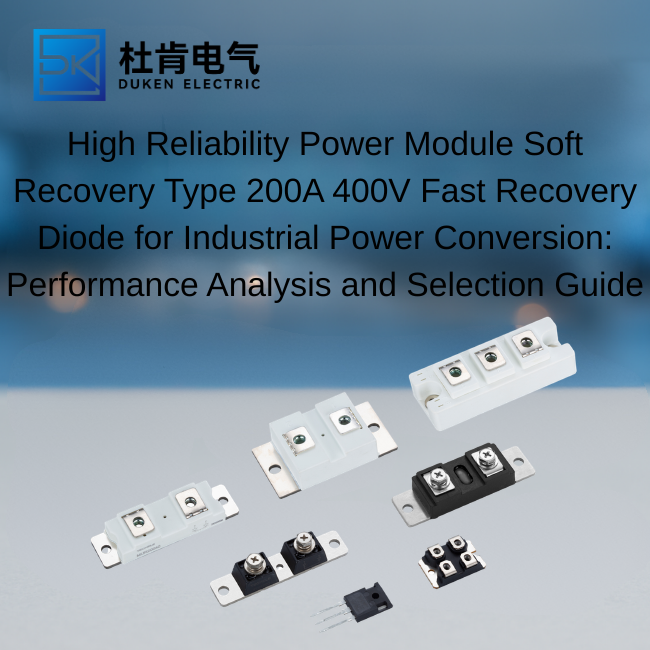
High Reliability Power Module Soft Recovery Type 200A 400V Fast Recovery Diode for Industrial Power Conversion: Performance Analysis and Selection Guide
Introduction
A high reliability power module soft recovery type 200A 400V fast recovery diode is an important semiconductor component for industrial power conversion systems that require stable switching performance, low power loss, and long-term operational reliability. With the rapid development of inverter drives, welding equipment, industrial rectifiers, battery charging systems, and high-efficiency converters, selecting the correct diode technology has become a critical factor for equipment manufacturers and power electronics engineers.
Unlike standard rectifier diodes, soft recovery fast recovery diodes are designed to provide smoother reverse recovery behavior during switching transitions. This helps reduce voltage spikes, electromagnetic interference, and electrical stress on surrounding components. For high-current applications, the combination of a 200A current rating and 400V reverse voltage capability provides a practical solution for demanding industrial environments.
This article explains the technical characteristics, application advantages, parameter selection methods, and comparison with other semiconductor technologies to help engineers and purchasing teams choose the right diode solution.
Understanding Soft Recovery Fast Recovery Diode Technology
This reverse recovery process directly affects:
Switching losses
System efficiency
Thermal performance
Electromagnetic interference
Semiconductor lifetime
A conventional diode may generate high recovery current during switching, creating additional electrical stress. Soft recovery technology improves this process by controlling the recovery characteristic and allowing the current to decrease more smoothly.
The main advantages of soft recovery technology include:
Reduced voltage overshoot
Lower switching noise
Improved system stability
Better compatibility with IGBT and MOSFET switching devices
Longer operating lifetime
A 200A 400V fast recovery diode with soft recovery characteristics is particularly suitable for industrial applications where high current operation and switching reliability are required.
Key Technical Parameters for 200A 400V Fast Recovery Diode Selection
Selecting a suitable diode requires a complete understanding of electrical and thermal parameters.
Reverse Recovery Time and Soft Recovery Characteristics
Reverse recovery time (trr) is one of the most important specifications for high-speed power applications.
A shorter recovery time can reduce:
Switching energy loss
Heat generation
Converter losses
However, extremely fast recovery may increase voltage spikes and electromagnetic interference.
Soft recovery technology provides a balanced solution by achieving:
Efficient switching
Reduced electrical stress
Improved system reliability
For industrial inverter systems, this balance is often more valuable than maximum switching speed alone.
Forward Voltage Drop and Conduction Loss
Forward voltage drop determines the energy loss when current passes through the diode.
In high-current applications, even a small reduction in forward voltage can significantly influence thermal performance.
Low conduction loss provides:
Higher system efficiency
Reduced cooling requirements
Lower operating temperature
Improved component lifetime
For continuous industrial operation, controlling conduction loss is essential for maintaining stable performance.
Reverse Voltage Rating and Surge Current Capability
The 400V reverse voltage rating allows the diode to operate safely in medium-voltage industrial circuits.
Engineers should also evaluate surge current capability because industrial equipment frequently experiences temporary electrical stress.
Typical causes include:
Equipment startup
Sudden load changes
Short-duration overload conditions
Switching disturbances
A high reliability diode must maintain stable performance under these conditions.
Thermal Management Performance
Thermal design directly affects semiconductor reliability.
Important factors include:
Junction temperature
Thermal resistance
Heat sink structure
Cooling method
Package design
A well-designed power module improves heat transfer and prevents excessive temperature rise during continuous operation.
Industrial Applications of Soft Recovery 200A 400V Fast Recovery Diodes
Inverter Drive Systems
Industrial inverter drives require efficient semiconductor components to control motors and electrical loads.
Fast recovery diodes are commonly used in:
Freewheeling circuits
Reverse current protection
Energy recovery paths
Applications include:
Industrial motors
Pumps
Fans
Automation equipment
Soft recovery characteristics help reduce switching stress and improve inverter reliability.
Welding Machine Applications
Modern inverter welding machines operate at high switching frequencies and require reliable semiconductor solutions.
A high reliability soft recovery diode helps improve:
Output stability
Energy efficiency
Thermal performance
Equipment lifetime
Welding systems often experience rapid current changes, making surge capability and recovery behavior especially important.
Industrial Rectifier Systems
Industrial rectifiers convert AC power into controlled DC output for many manufacturing processes.
Applications include:
Battery charging systems
Industrial DC power supplies
Electrochemical processing
Power conversion equipment
Soft recovery diode technology improves efficiency while maintaining stable operation.
Comparison With IGBT, MOSFET, SiC Diode and Rectifier Technologies
Soft Recovery Diode vs IGBT Module
IGBT modules are widely used as active switching devices in industrial converters.
Advantages of IGBT:
High voltage capability
Strong power handling
Precise switching control
Fast recovery diodes usually operate together with IGBT modules rather than replacing them.
The diode provides:
Current circulation paths
Reverse energy handling
Protection during switching operation
Soft Recovery Diode vs MOSFET
MOSFET devices offer excellent switching speed and are commonly used in high-frequency applications.
Advantages include:
Fast switching response
Low gate drive power
Efficient operation at lower voltage
However, for high-current industrial applications, fast recovery diodes often provide better:
Cost efficiency
Current capability
Thermal durability
Soft Recovery Diode vs SiC Diode
SiC diodes represent advanced semiconductor technology.
Advantages include:
Extremely low switching losses
High temperature capability
Excellent efficiency
However, soft recovery silicon fast recovery diodes remain popular because they provide:
Mature manufacturing technology
Lower cost
Reliable industrial performance
Soft Recovery Diode vs Standard Rectifier Diode
Standard rectifier diodes are suitable for low-frequency applications.
Soft recovery fast recovery diodes are preferred when systems require:
Higher switching frequency
Lower losses
Reduced electrical noise
Better reliability
Industrial Buyer Selection Recommendations
When selecting a high reliability power module soft recovery type 200A 400V fast recovery diode, buyers should evaluate both technical specifications and supplier capability.
Electrical Specification Evaluation
Important parameters include:
Forward current rating
Reverse voltage rating
Reverse recovery time
Forward voltage drop
Leakage current
Surge current capability
These specifications determine whether the diode can meet application requirements.
Package and Installation Requirements
Power module design should consider:
Heat sink compatibility
Mounting structure
Cooling environment
Mechanical stress
Correct installation improves thermal performance and prevents premature failure.
Supplier Reliability
Industrial buyers should evaluate:
Manufacturing capability
Quality control system
Product consistency
Technical support
Long-term supply capability
A reliable supplier helps reduce production risks and maintain stable equipment manufacturing.
Future Trends in High Power Semiconductor Applications
Industrial power electronics are moving toward higher efficiency, higher power density, and smarter energy management.
Future trends include:
Advanced thermal materials
Compact power modules
Higher switching frequency systems
Intelligent control technologies
Although SiC technology continues expanding, soft recovery fast recovery diodes remain important because they provide a practical balance between:
Performance
Reliability
Cost
They continue to support applications in industrial automation, renewable energy equipment, electric vehicle charging, and advanced manufacturing systems.
Conclusion
A high reliability power module soft recovery type 200A 400V fast recovery diode provides a dependable semiconductor solution for industrial power conversion applications requiring stable switching behavior, low losses, and long service life.
By carefully evaluating reverse recovery characteristics, conduction loss, thermal performance, surge capability, and package design, engineers can select the most suitable diode solution for inverter systems, welding machines, and industrial rectifiers.
Soft recovery technology provides an effective balance between switching efficiency and electrical stability, making it a reliable choice for modern industrial power electronics.
FAQ
1. What is a soft recovery fast recovery diode?
A soft recovery diode is designed to provide a smoother reverse recovery process, reducing voltage spikes and electromagnetic interference.
2. Why choose a 200A 400V fast recovery diode?
It provides high current capability and suitable voltage protection for demanding industrial power conversion applications.
3. Where are soft recovery fast recovery diodes used?
They are widely used in inverter drives, welding machines, rectifiers, battery chargers, and industrial power modules.
4. How does soft recovery improve system reliability?
It reduces switching stress, electrical noise, and thermal impact on semiconductor components.
5. What should buyers check before purchasing?
Buyers should evaluate current rating, voltage rating, recovery time, thermal performance, package design, and supplier reliability.
Meta Title
Soft Recovery 200A 400V Fast Recovery Diode Guide
Meta Description
High reliability soft recovery 200A 400V fast recovery diode guide covering switching performance, thermal design, applications and industrial selection.
Focus Keyword
High reliability power module soft recovery type 200A 400V fast recovery diode
READ MORE: